How to reduce restaurant food waste without complicating operations
Food waste in a restaurant is not limited to what customers leave on their plates. Waste also occurs during food preparation, through over-ordering, improper storage, poorly sized portions or preparing too much mise en place before a quieter day.
If you want to reduce food waste, do not start by randomly cutting supplier orders. First find out where the waste is actually occurring. Only then can you improve purchasing, menu planning, portioning and kitchen organisation.
Start by measuring what you throw away
The simplest tool is a waste log. You do not need an advanced inventory management system to begin with. A spreadsheet or form where staff regularly record discarded products is enough.
For each case of waste, it is worth recording:
- the date,
- the product or dish,
- the approximate quantity,
- the reason it was discarded,
- where the waste occurred.
You can divide the reasons into a few simple categories:
- expiry or spoilage,
- too much product prepared,
- preparation error,
- food returned from the dining area,
- unused surplus,
- cancelled order,
- damaged product.
After a few weeks, recurring problems will start to become visible. If you most often throw away prepared vegetables at the end of Monday and Tuesday, the problem is probably the amount of mise en place. If the same side dishes regularly come back uneaten on plates, it is worth looking at portion sizes.
Do not record only the cost
Simply writing “PLN 80 worth of products discarded” does not tell you very much. A much more important question is: why were they discarded. Only when you know the cause can you take action.
It is also worth comparing waste with sales levels. If one week was exceptionally busy, higher product usage does not necessarily indicate a problem. However, if sales remain similar while waste increases, it is worth looking for a specific cause.
Base purchasing decisions on sales history
Ordering “by instinct” works until the restaurant starts seeing significant differences between different days of the week. Friday evening may look completely different from Monday afternoon.
When planning deliveries, it is therefore worth checking:
- sales from previous weeks,
- differences between days of the week,
- the most popular dishes,
- the busiest hours,
- reservations and orders placed in advance,
- events that may unusually increase or reduce customer traffic.
Example: if sales of a salmon dish have been low for several Tuesdays in a row, there is little point in preparing the same amount of product as you would before Saturday evening. On the other hand, before Friday it does not make sense to reduce stock simply because the previous day was quieter.
It is best to compare similar days and periods. Monday with Monday, weekend with weekend, rather than looking only at total sales from one week to the next.
FIFO and simple labelling reduce storage waste
FIFO means “First In, First Out”, which means using products that arrived at the restaurant earlier before newer stock. The rule itself is simple, but it needs to be visible in everyday operations.
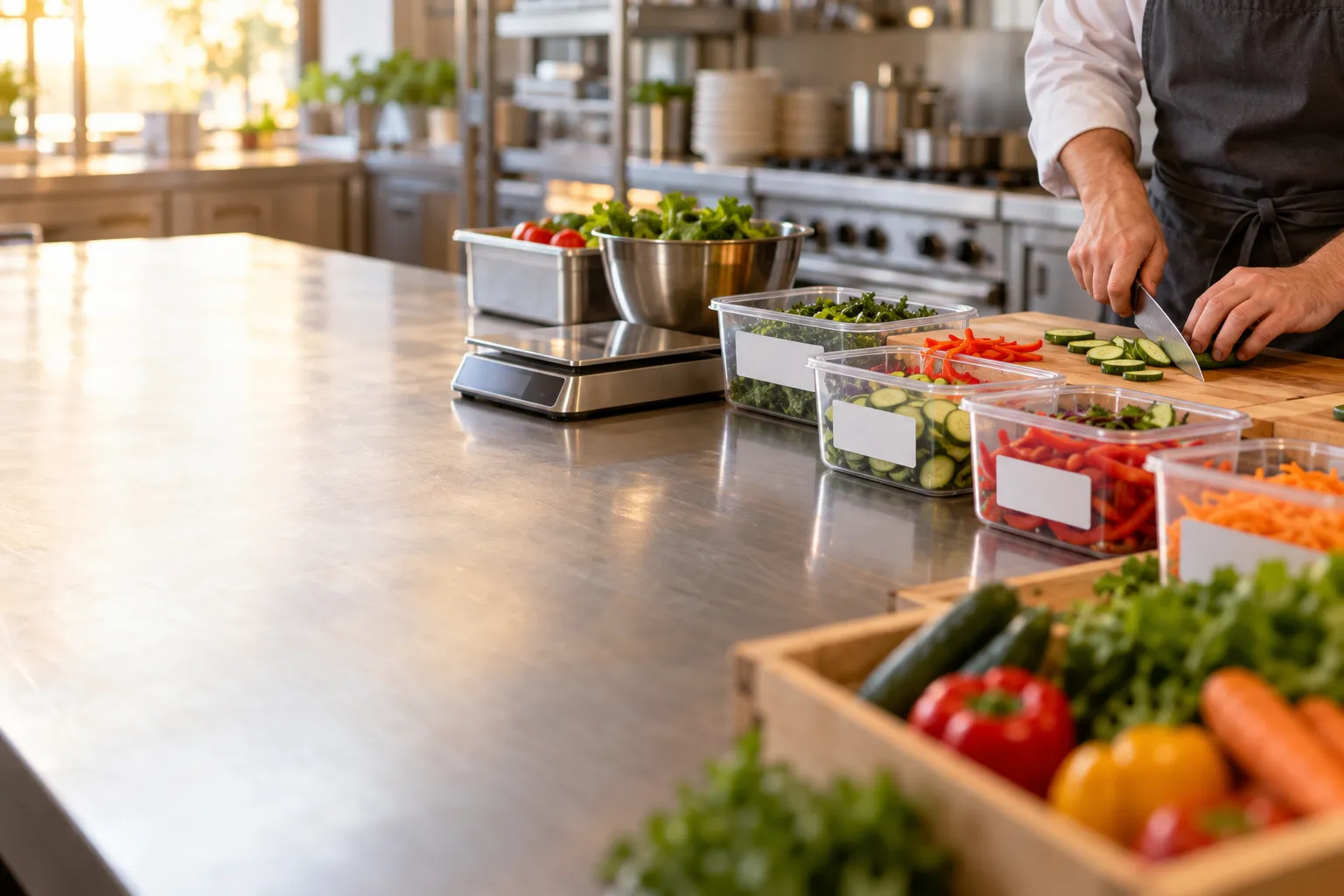
Products should be arranged so that an older delivery does not disappear at the back of the fridge behind a newer one. After opening a package or preparing a semi-finished product, it is worth labelling the container according to the procedure used in the restaurant.
Consistency matters most. If one shift labels products and another does not, after a few days it becomes difficult to determine which package should be used first.
A simple check at the beginning or end of a shift can help:
- check products with short use-by dates,
- move older packages to an easily accessible place,
- label opened and prepared products,
- decide what needs to be used first.
Prepare mise en place for the expected level of demand
Preparing everything “just in case” can make the beginning of a shift easier, but it increases the risk of waste if customer traffic is lower than expected.
It is better to divide preparation into stages. You can prepare some items before opening and then make additional batches depending on actual demand.
Example: at 19:00 on Friday, preparing a larger quantity of popular sides may be justified. At 15:00 on Monday, preparing the same amount may mean that some products remain unused.
It is useful to combine:
- sales history,
- reservations,
- scheduled orders,
- the current number of orders,
- the experience of the person managing the shift.
The aim is not to predict every order perfectly. The goal is to reduce situations where the kitchen prepares large quantities of food without any data to support the decision.
A shorter menu can mean fewer products to keep in stock
Every menu item requires specific ingredients. If you have a very extensive menu in which many products are used for only one dish, the risk that some stock will go unused increases.
It is worth reviewing the menu and asking a few questions:
- which dishes sell least often,
- which require unique ingredients,
- whether one ingredient can sensibly be used in several dishes,
- whether some dishes are very similar,
- whether you offer more variants than customers actually need.
This does not mean automatically removing every less popular dish. Some items may be important to the character of the restaurant. However, it is worth knowing which menu items require you to keep stock that is used only rarely.
You can read more about analysing sales and basic metrics in the article about restaurant KPIs worth tracking.
Control portion sizes
If customers regularly leave the same element of a dish uneaten, the problem may be the portion size or its composition.
Pay attention to what comes back from the dining area. The information “customers often leave half of the chips” is more useful than the general statement that “a lot of food is left over”.
Reducing portion sizes should not be done at random. First check what customers are actually leaving and whether the issue affects all dishes or only a specific one.
Standardising portions also helps the kitchen. If one person serves 150 grams of a side and another serves 250 grams, it becomes difficult to predict ingredient usage and calculate the real profitability of the dish.
Use surplus ingredients deliberately, not randomly
If a product is approaching the point when it needs to be used, it may sometimes make sense to include it in a dish of the day or a temporary menu item. However, this needs to make culinary sense and comply with the food safety rules followed by the restaurant.
Example: you have more fresh vegetables than expected and they are still perfectly suitable to use. Instead of waiting for them to lose quality, you can plan a dish for the next service that naturally uses them.
However, do not treat the “dish of the day” as a way to hide random leftovers. Customers should receive a proper dish prepared to the restaurant's normal standards.
Quickly stop selling a dish you can no longer prepare
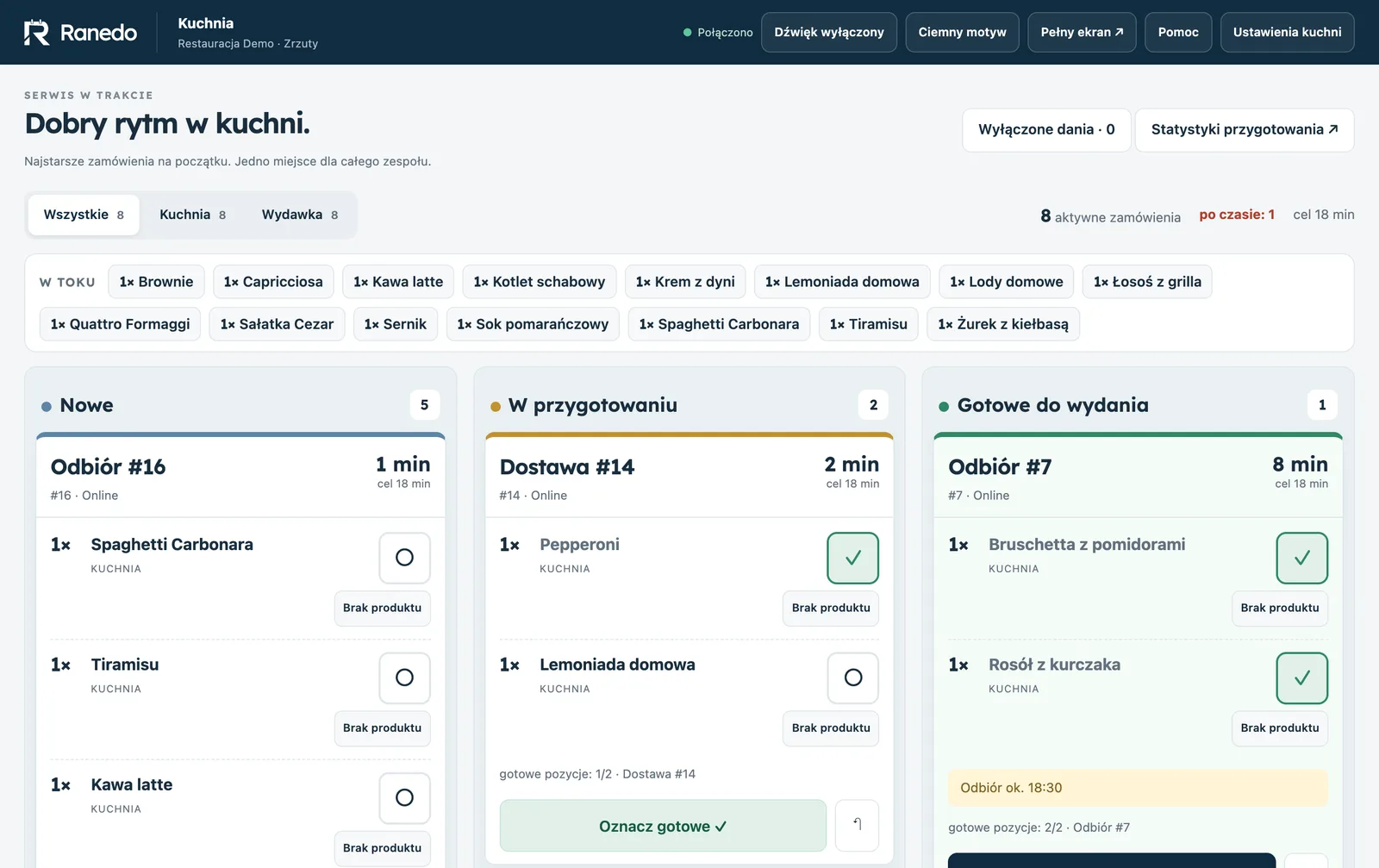
Food waste can also occur when information about an unavailable product reaches front-of-house staff too late.
Imagine Saturday at 20:00. One of the key ingredients in a popular dish runs out. The waiter continues selling it or more online orders continue to arrive because nobody has updated its availability.
The kitchen starts preparing the other parts of the order, only to discover later that the entire order cannot be completed. Staff then have to contact the customer, change the order, and some of the prepared ingredients may go unused.
That is why it is important to be able to stop selling an unavailable dish quickly and to have a clear procedure defining who makes that decision and who can make the dish available again.
Scheduled orders help you assess future workload earlier
An order placed in advance also provides useful information for the kitchen. If you can see a large order scheduled for the evening in the morning, you can take it into account when preparing the workstation.
This is particularly useful for larger orders or products that require preparation in advance. It still does not replace sales forecasting, but it reduces some of the uncertainty.
On the other hand, be careful about preparing products for an order that may still be changed or cancelled. The earlier you begin preparation, the more important it becomes to have a clear procedure for confirming and fulfilling orders.
What should you do with surplus food the restaurant will not use?
Sometimes, despite good planning, perfectly usable food remains that the restaurant will not be able to use in time. Depending on the type of product and local options, you can consider donating surplus food to food aid organisations or other entities that can legally and safely accept it.
Before doing so, it is worth checking current requirements relating to food safety, liability, storage, transport and documentation. The rules may depend on the type of food and how it was prepared, so donation should not be treated as a universal solution for every product.
How can Ranedo help reduce waste?
Ranedo is not an inventory management system. It does not manage recipes, calculate raw ingredient stock levels or calculate food cost. You need to manage this data outside the system.
It can, however, provide sales information useful for better planning. In all plans, analytics show, among other things, the most popular dishes and the busiest hours. You can use this data when planning purchases and mise en place.
In all plans, you can also temporarily pause sales of a dish on the menu. If a key ingredient is running out, new orders do not have to continue arriving for an item the kitchen can no longer prepare.
In the Plus and Pro plans, the kitchen display allows staff to mark a product as unavailable. The KDS also shows scheduled orders, giving the kitchen earlier visibility of some of its future workload. You can read more about organising kitchen orders in the article about Kitchen Display Systems and paper tickets.
A simple plan for reducing food waste over the next few weeks
Do not try to change everything at once. Start with a simple process:
- Start a waste log and record the reason for every significant case.
- After one or two weeks, check which causes appear most often.
- Compare them with sales history by day of the week.
- Adjust supplier order quantities where regular surpluses are visible.
- Check your FIFO process and how opened products are labelled.
- Adjust mise en place to actual demand.
- Review your least popular menu items and their unique ingredients.
- Check portion sizes and what most often comes back on plates.
- Set a simple procedure for quickly pausing unavailable dishes.
After another few weeks, review the waste log again. This will show you not only how much you are throwing away, but more importantly whether the specific causes have changed.
Use sales data to plan more effectively
In Ranedo, sales analytics, most popular dishes, busiest hours, scheduled orders and the ability to pause sales of a dish help you respond more effectively to real demand. You can check the available plans or create an account and use the free first month with all features included in your selected plan.
Frequently asked questions
Where should you start when reducing food waste?
Start with measurement. For several weeks, record what you throw away, how much and why. Without this, it is easy to focus on areas that are not actually responsible for most of your waste.
Does a shorter menu always mean less food waste?
Not always, but it can reduce the number of ingredients that are only used occasionally. It is best to check sales of individual menu items and the stock required to keep them available.
How often should you analyse food waste?
It is best to record waste as it occurs and prepare a summary regularly, for example once a week. This makes it easier to connect waste with specific days, shifts and sales levels.
Does Ranedo calculate inventory levels and food cost?
No. Ranedo does not have an inventory module or recipe management and does not calculate food cost. It does, however, provide sales data that you can use when planning purchasing and kitchen preparation.
What should you do if an ingredient runs out during service?
The most important thing is to communicate the information quickly and stop further sales of the dish if it can no longer be prepared. In Ranedo, you can pause sales of a menu item, while the Plus and Pro plans allow you to mark a product as “Out of stock” on the kitchen display.
Share this article: