Delivery app commissions vs your own online ordering
Delivery platforms can be a good source of new orders. A customer opens an app, browses restaurants nearby and may discover a place they did not know before. The problem starts when a large share of regular customers continues ordering through an intermediary even though they already know your restaurant.
In this model, commission may be charged on every subsequent order according to the terms of the specific platform. At the same time, the relationship with the customer takes place mainly within that platform. Your restaurant is one of many options on a list, and your ability to build your own customer database is limited.
This does not mean you need to stop using delivery platforms immediately. A more practical approach is to use them to acquire new customers while developing your own ordering channel in parallel for people who already know your restaurant.
The problem: commission increases as sales increase
In a commission-based model, the cost of the channel is directly linked to the value of orders processed through it. The more you sell through the intermediary, the higher the total commission can become.
We do not provide specific platform rates here because pricing, packages and terms can change. Before making a decision, check your current agreement and calculate your actual cost.
Example calculation
Assume a restaurant processes 600 orders per month through a platform, with an average order value of PLN 70.
Total sales through this channel are:
600 × PLN 70 = PLN 42,000 per month
Now assume, purely as an example, that the total commission cost of this channel is equivalent to 20% of sales.
PLN 42,000 × 20% = PLN 8,400
In this example scenario, the channel costs PLN 8,400 per month.
This does not mean every platform charges this rate. It is simply an example showing the mechanism: with a percentage-based model, the cost increases together with turnover.
By comparison, your own ordering system can operate on a fixed subscription. In that case, the cost of the system itself does not increase proportionally with the number of orders.
The second cost: regular customers still return through the intermediary
A delivery platform provides the greatest value when it helps you reach someone who does not yet know your restaurant. From an economic point of view, it may be less favourable when the same customer continues ordering only through the intermediary app for months afterwards.
Imagine a simple scenario. Someone discovers your pizzeria through a platform for the first time, places an order, enjoys the food and wants to order again a week later. If the only channel they know is the intermediary app, they will probably return there.
If, however, they receive information with their order telling them that next time they can order directly from the restaurant website, you give them an alternative.
The point is not to force customers to change their habits. The point is to make sure they know your direct ordering channel exists.
The third problem: the customer database remains outside the restaurant
Your own sales channel gives you the opportunity to build a direct relationship with people who buy from your restaurant. When orders are processed exclusively through an intermediary, the amount of customer data available to the restaurant depends on the rules of the specific platform.
This matters because your own database can later be used for:
- analysing order history,
- recognising regular customers,
- running a loyalty programme,
- creating customer segments,
- running e-mail or SMS campaigns after obtaining the appropriate consent.
If you do not build your own database, the next time you run a campaign you may have to reach the customer again through an external channel.
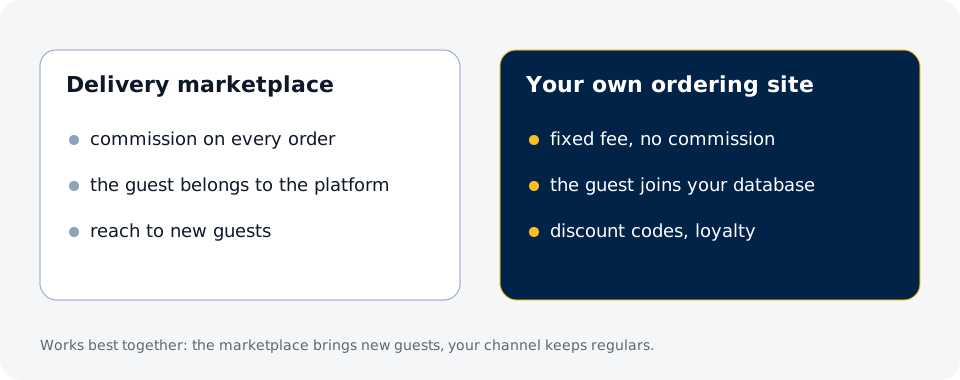
On a delivery platform, you compete on the same list as other restaurants
A customer using an intermediary app will usually see many restaurants side by side. They can compare cuisines, prices, promotions, delivery times and other parts of the offer.
Even if they were looking at your menu a moment ago, a few seconds later they may switch to another restaurant.
On your own website, the situation is different. Someone who visits your restaurant's address is already in your brand environment. They are not shown dozens of competing restaurants by the same platform.
This does not mean your own website will automatically outperform a delivery platform. You still need to drive traffic to it and make the ordering process convenient.
If your basket is confusing or payment takes too long, customers may return to the app they already know. That is why it is also worth looking at how to improve the online ordering process in a restaurant.
Does this mean you should stop using delivery platforms?
No. For many restaurants, gradually building a direct channel is more sensible than suddenly switching off intermediaries.
A platform can give you access to people who:
- do not know your restaurant yet,
- are looking for food in a specific area,
- are comparing several restaurants,
- would not otherwise visit your website directly.
You can therefore treat the platform as one channel for acquiring new customers and your own website as the place you direct people who already know your restaurant.
How to gradually move regular customers to your own channel
The best moment is when the customer has just received their order and is happy with the purchase. You do not need an aggressive campaign. It is enough to consistently let them know that their next order can be placed directly.
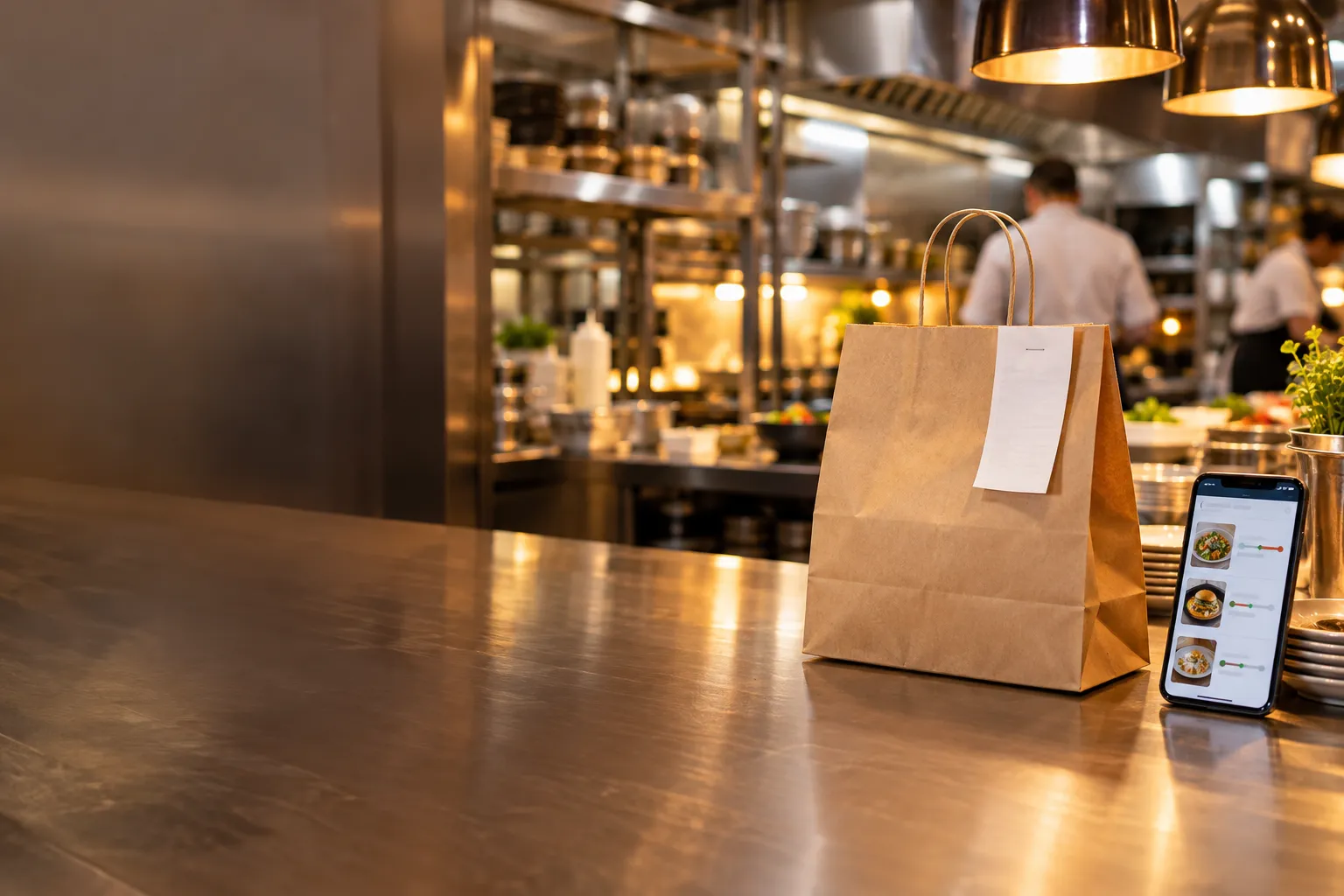
Add a leaflet to the bag
You can include a simple card with each order showing your website address and a short message:
Next time, you can order directly from our website.
The website address or QR code should be the main focus. Do not fill the leaflet with a dozen different messages.
Put a QR code on the packaging
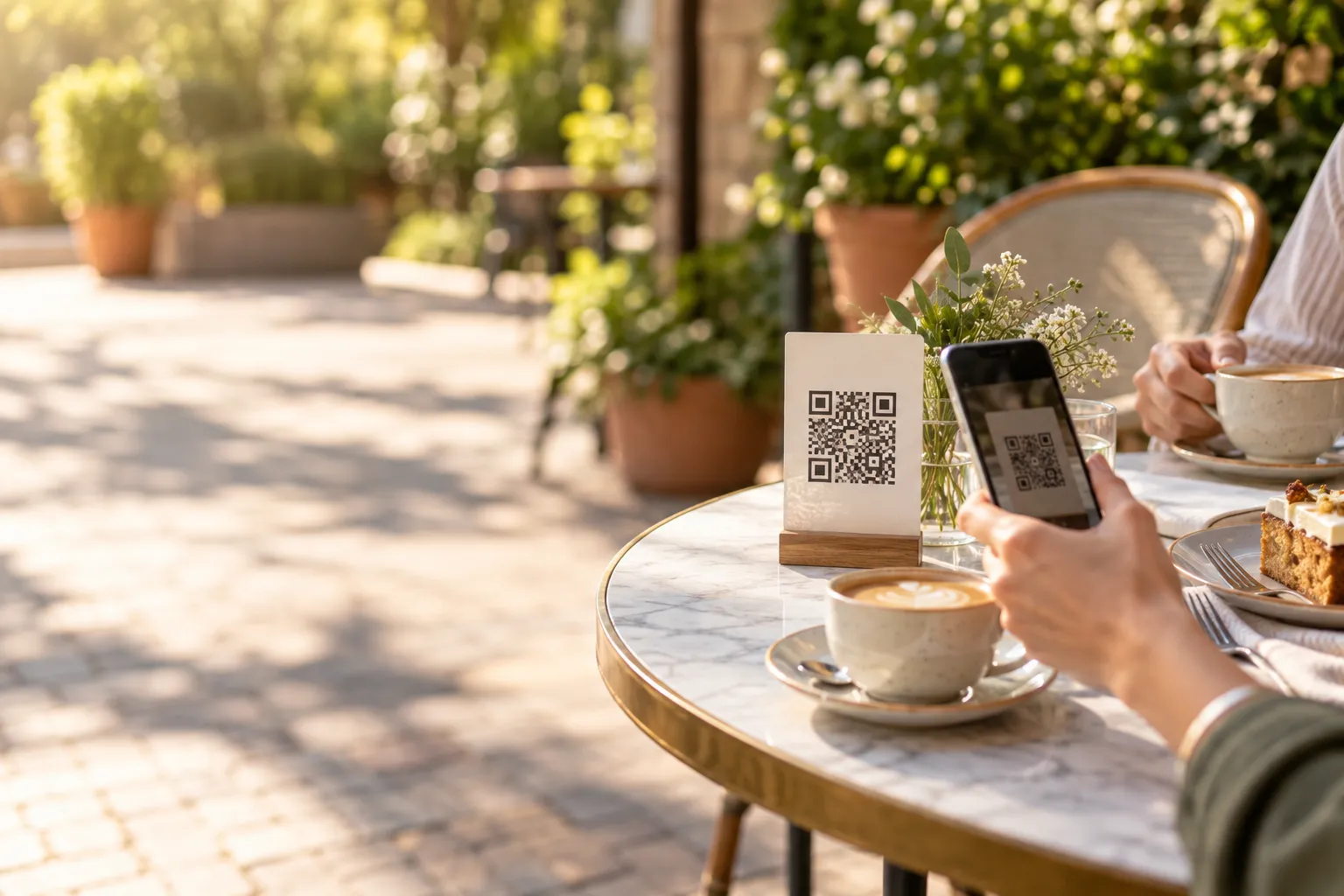
If you use your own boxes, stickers or paper bags, you can add a QR code linking directly to your online menu.
The customer does not then need to remember the website address. The next time they want to order, they simply scan the code.
Offer a benefit for the first direct order
You can offer a discount code, free delivery or a free product on the first order placed through your own website. However, calculate the cost of the promotion first.
For example, assume that a one-off benefit costs you PLN 8. If it encourages a regular customer to start using a channel without commission on every order, you can compare the cost of that one-off incentive with the ongoing cost of processing orders through the intermediary.
However, do not assume that every customer will remain in your direct channel. The promotion should still make financial sense even if some people use it only once.
Direct Google and social media traffic to your own website
If someone searches for the name of your restaurant or visits its social media profile, they probably already know you.
In those places, it is worth linking the “Order” button directly to your own website rather than automatically sending the customer to an intermediary.
A delivery platform can acquire new customers. Your own communication channels, on the other hand, can be used to direct people who are already interested in the restaurant towards ordering directly.
Your own channel requires your own delivery organisation
With direct orders, you need to define where you actually deliver and under what conditions. Simply writing “delivery within the city” on your website is not enough.
It is worth defining:
- the delivery area,
- the delivery fee,
- the minimum order value,
- the fulfilment time for a given area,
- the hours during which you accept orders.
Example: delivering two kilometres from the restaurant may be viable for a smaller order than delivering to the other side of the city. Instead of applying one rule to every address, you can divide the area into zones.
You can read more about this model in the article about delivery zones and minimum order values.
Should prices be the same on the delivery platform and your own website?
This is a business decision for the restaurant and should take into account the terms of your agreements with the platforms you use. You should not change prices between channels without first checking the applicable rules of cooperation.
From an economic point of view, however, it is worth calculating the real cost of sales in each channel.
With your own orders, costs may include:
- the system subscription,
- payment provider fees,
- the cost of your own delivery,
- promotion and marketing costs.
With a platform, you also need to include the financial terms agreed with the intermediary. Compare the total cost of processing an order, not just one line item.
How do you calculate whether your own channel makes sense?
Start with real data from the previous month.
- Check the number of orders placed through the platform.
- Calculate their total value.
- Check the actual costs resulting from your agreement with the platform.
- Calculate the payment provider cost in your own channel.
- Add the cost of the online ordering system.
- If you handle delivery yourself, include the delivery cost as well.
Then prepare several scenarios. Do not assume that you will move all orders immediately.
Assume you currently receive 600 orders through the intermediary. You can calculate what the result would look like if 50, 100 or 200 orders per month were placed through your own website instead.
This gives you a much more realistic picture than assuming all traffic will move to the new website overnight.
How does your own ordering channel work in Ranedo?
Ranedo is a system for building your restaurant's own ordering channel. It is not a delivery platform aggregator and does not integrate with delivery platforms.
All Ranedo plans use a fixed subscription with 0% commission on orders. The Start plan covers up to 99 orders in each month of the billing period, and Plus and Pro have no limit on the number of orders.
The Start plan costs 79 PLN net per month and includes, among other things, your own restaurant website with online ordering, a menu, collection and delivery, and delivery zones.
Online payments can be processed through Tpay, Przelewy24 or PayU. The restaurant signs the agreement with the payment provider, and the money reaches its account according to the provider's terms. Ranedo does not charge any additional commission on these transactions.
Delivery zones in your own channel
In Ranedo, you can define a delivery area as a radius from the restaurant, an area drawn on a map or a set of postcodes. For each zone, you can separately set:
- the delivery price,
- the minimum order value,
- the delivery time.
The customer's address is checked automatically.
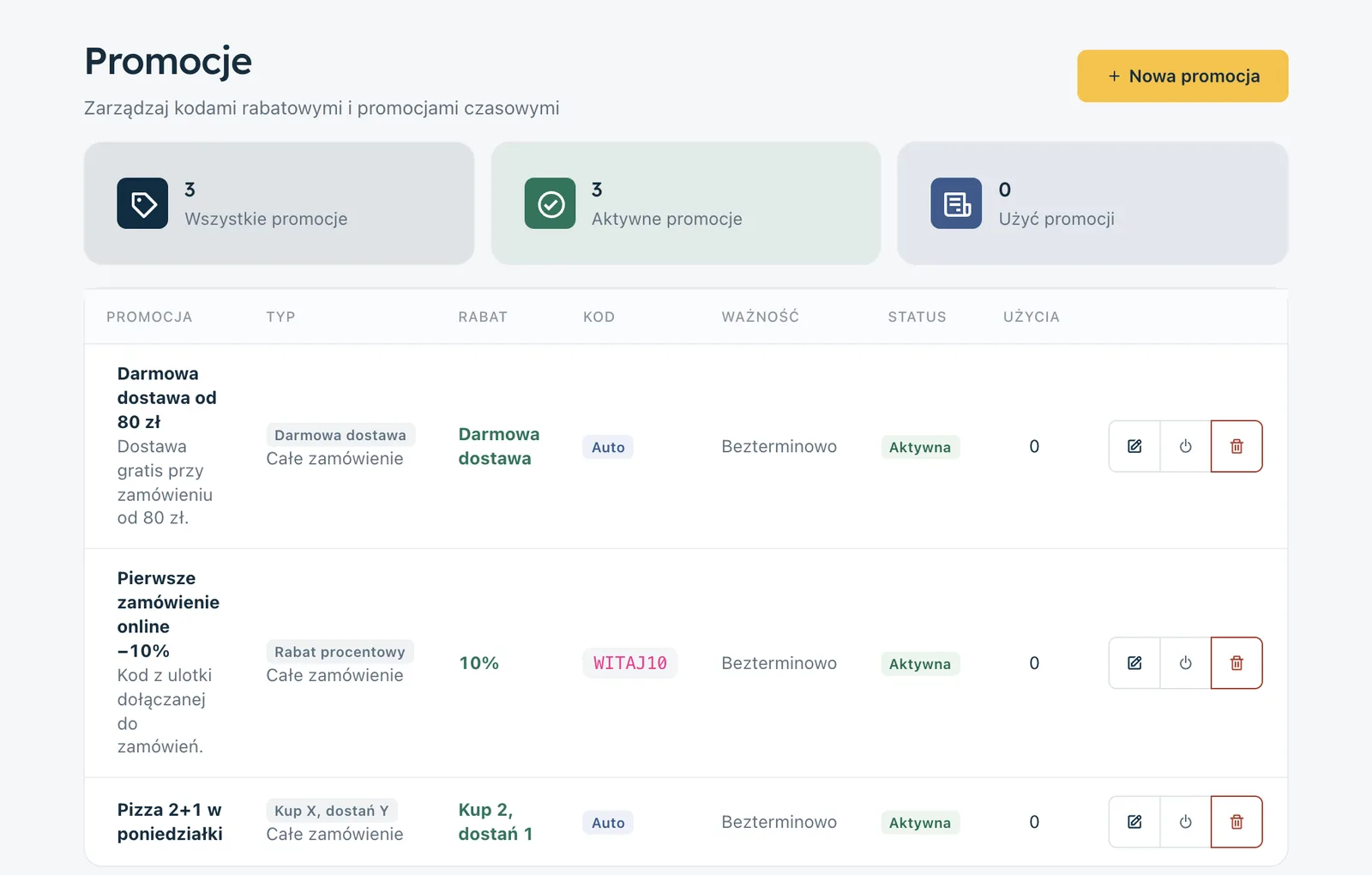
Plus: your own channel also starts building your customer database
In the Plus and Pro plans, Ranedo provides additional tools that are useful when moving regular customers towards direct ordering.
You can create:
- discount codes,
- percentage and fixed-value discounts,
- free delivery,
- a free product,
- “buy X, get Y” promotions,
- a loyalty programme.
These plans also include a CRM customer database with order and visit history, spending, points, notes, tags and segments.
After obtaining the appropriate consent, you can run e-mail and SMS campaigns. SMS messages are charged separately.
Plus and Pro also allow you to connect your own domain, for example www.yourrestaurant.pl, instead of using only an address in the Ranedo subdomain.
The best model does not have to mean choosing only one channel
A delivery platform and your own website can serve two different purposes.
A platform can help you acquire new customers. People using it browse many restaurants and may discover yours for the first time.
Your own website allows you to build a direct channel for people who already know you. You do not pay Ranedo commission on the value of each order, and you can develop your own customer database.
In practice, a sensible strategy may look like this:
- keep the delivery platform as a source of new customers,
- launch your own ordering website,
- add its address to packaging and materials in the restaurant,
- direct search engine and social media traffic to it,
- encourage regular customers to order directly,
- regularly compare the number and cost of orders across both channels.
You therefore do not have to choose between “delivery platform or own website”. You can gradually change the proportions and see which channel performs each role best.
Build your own ordering channel with Ranedo
Ranedo operates on a fixed subscription with 0% commission on orders. Starting with the Start plan at 79 PLN net per month, you can launch your own website with a menu, online ordering, payments and delivery zones. The Plus and Pro plans also include promotions, discount codes, CRM and a loyalty programme.
Check the Ranedo plans or create an account and use the free first month with all features included in your selected plan.
Frequently asked questions
Does having your own online ordering mean I should stop using delivery platforms?
No. A delivery platform can still be used to acquire new customers. You can develop your own channel alongside it, especially among people who already know your restaurant.
How much commission do delivery platforms charge?
The terms depend on the specific platform, agreement and scope of services. Check the current pricing and your own agreement instead of basing your decision on general rates found online.
Does Ranedo charge commission on orders?
No. Ranedo operates on a fixed subscription and does not charge commission on order value. Plus and Pro have no limit on the number of orders, and Start covers up to 99 orders in each month of the billing period.
Does Ranedo charge a fee for BLIK or card payments?
Ranedo does not charge commission on payments. The restaurant signs its own agreement with Tpay, Przelewy24 or PayU and settles directly with the selected provider according to its current terms.
Will orders from delivery platforms appear in Ranedo?
No. Ranedo does not integrate with delivery platforms. It is a solution for running the restaurant's own sales channel, not an aggregator of orders from external platforms.
Share this article: