How to create a restaurant loyalty programme that works

A loyalty programme in a small restaurant should be easy for customers to understand and simple for staff to manage. If the rules are complicated, the rewards are not attractive enough and staff forget to mention the programme at the till, even the best system will not help. On the other hand, an overly generous programme can quickly turn into an expensive discount given to everyone without control.
It is best to start with one question: what exactly do you want to achieve. Only then should you choose points, stamps, a rewards catalogue and how you will communicate the programme.
Start by defining the goal of your loyalty programme
A loyalty programme should not exist simply because “your competitors have one too”. In a small restaurant, it is worth choosing one main objective and building the programme around it.
The most common goals include:
- encouraging customers to return more often,
- increasing the number of direct orders,
- building your own customer database,
- increasing sales of selected products or meal deals,
- maintaining relationships with people who have already visited your restaurant.
Example: if most new customers visit once and never return, the aim of the programme should be to encourage a second and third purchase. If you have many regular customers but few direct orders, you can focus the programme on benefits available when ordering through your own website.
The goal should be specific. “More loyalty” is difficult to measure. “More returning customers” or “higher purchase frequency among people enrolled in the programme” already gives you a clear point of reference.
Points, stamps or a permanent discount?
There is no single mechanism that works for every restaurant. Each one has different advantages and limitations.
Stamps — the simplest model
A classic card such as “buy 9 coffees and get the 10th free” is easy to understand. There is no need to explain conversion rates or a rewards catalogue.
This solution works well when:
- customers frequently buy the same or similar product,
- the average transaction value is fairly consistent,
- the offer is simple,
- you want to introduce a mechanism without advanced analytics.
The downside of traditional stamps is the limited amount of data. You know that someone received a reward, but you do not necessarily see their previous order history, visit frequency or preferences.
Points — greater flexibility
A points-based programme gives you more options. Customers collect points for orders and can then exchange them for rewards defined by the restaurant.
This works particularly well when you have a broader menu and want to reward different types of purchases. You do not have to limit the programme to one coffee, one pizza or one meal deal.
An example mechanism could work like this:
- points are awarded for each order according to a defined rule,
- after reaching a certain threshold, the customer can receive a selected reward,
- more expensive or more attractive rewards require more points.
The conversion rate should be simple. If a customer needs a calculator to work out whether a reward is worthwhile, the programme is too complicated.
Permanent discounts — simple, but easy to overdo
A permanent discount for regular customers is easy to introduce, but it has one drawback: it reduces the value of practically every subsequent purchase.
If you give a regular customer a discount on the entire menu every time they visit, over time they may start treating the discounted price as the normal price. You also lose the ability to influence which products you want to encourage them to buy.
For this reason, a catalogue of specific rewards often works better for many restaurants than a permanent discount on everything.
How do you set thresholds that are attractive but still protect your margin?
The biggest mistake is setting the first meaningful reward too far away. If customers have to make a large number of purchases before they receive any benefit, they may lose interest in the programme.
On the other hand, a reward that is earned too quickly may simply become an expensive discount.
A good approach is to create several levels:
- a small reward that can be reached relatively quickly,
- a medium reward for customers who return more often,
- a more attractive reward for the most active customers.
You do not need to create an extensive catalogue straight away. In a small restaurant, a few well-considered rewards are usually better than dozens of options that nobody remembers.
How should you choose rewards?
The best reward is not always the one with the highest selling price. What matters is the relationship between the cost to the restaurant and the value perceived by the customer.
Example: assume that a drink costs PLN 12 on the menu, but its actual cost to the restaurant is much lower. For the customer, a “free drink” may be an attractive reward, while for the restaurant the cost is lower than giving a PLN 12 discount on the entire order.
The same principle can work with:
- a free dessert,
- an extra ingredient,
- a selected starter,
- free delivery,
- a product from a specific category.
This obviously depends on your menu and margins. Do not copy another restaurant's rewards catalogue without calculating the costs first.
Do not reward everything with the same discount
If the most popular reward is “10% off the entire order”, a loyalty programme can easily turn into permanent price cutting.
It is better to use rewards to promote products that have a high perceived value for the customer without creating excessive costs for the restaurant.
If you want to combine loyalty with time-limited offers, the article about restaurant promotions and discount codes may also be useful.
The programme needs to be visible to customers
Even a good programme will not work if nobody knows about it. Information should appear in several places, but without pushing the message at every opportunity.
At the till and during service
Staff should be able to explain the programme in one or two sentences.
Instead of a long explanation, a simple message is enough:
When you order from us, you collect points that you can later exchange for selected rewards.
Staff should also know:
- how to check a customer's points balance,
- how to record a redeemed reward,
- what to do if points have been calculated incorrectly,
- how to answer basic customer questions.
On the restaurant website
The programme rules should be explained in simple language. Customers should not have to search through lengthy terms and conditions to find basic information.
It is worth showing on the website:
- how points or rewards are earned,
- what the rewards catalogue looks like,
- how rewards can be redeemed,
- whether points expire,
- whether the programme applies to every ordering channel.
If the programme is intended to support direct orders, clearly explain where points are awarded. Your own ordering channel can also help reduce dependence on intermediaries, which we discuss in more detail in the article about delivery platform commissions and your own online ordering.
GDPR and marketing consent — joining a loyalty programme is not automatic consent to advertising
If you collect customer data as part of a loyalty programme, you should clearly explain why it is needed and how it will be used. Participation in the programme does not automatically mean consent to every form of marketing.
If you want to send e-mail or SMS campaigns, marketing consent should be handled separately and in accordance with applicable regulations. Customers should also be able to unsubscribe from communications.
This is general organisational guidance, not legal advice. If you are unsure how to prepare the programme terms, privacy policy or consent wording, it is worth consulting a specialist.
How do you measure whether a loyalty programme is working?
Do not judge the programme only by the number of people who have joined. You can have a large database of customers who rarely return.
The key question is: do programme members actually return more often and use the restaurant again.
Customer return rate
Check how many programme members made another purchase or visited the restaurant again.
Example: assume that 100 people joined the programme during a particular period. After some time, 35 of them made another purchase. This does not yet mean that the programme caused them to return, but it gives you a starting point for further analysis.
Visit frequency
Compare how often programme members return. If a typical regular customer previously visited once every few weeks and later starts visiting more often, check whether that change continues over a longer period.
Do not draw conclusions after just one week. Customer behaviour is influenced by many factors: seasonality, weather, local events, price changes and holiday periods.
Reward redemption
Check which rewards customers choose and which ones attract almost no interest.
If one reward is very popular but also expensive for the restaurant, it is worth recalculating whether it is still worthwhile. If another reward is never chosen, its perceived value may be too low or the threshold may be too high.
Activity in different customer segments
Not all customers behave in the same way. You can separately analyse frequent visitors, customers who mainly order online, or people who have not returned for a long time.
This approach is usually more useful than sending the same promotion to your entire database.
Common mistakes in loyalty programmes
Rules that are too complicated
If customers do not understand what they receive points for or how many points they need for a reward, the programme needs to be simplified.
The first reward requires too many visits
The first benefit should be achievable. If customers see no value for a long time, it is difficult to keep them interested.
Discounts on everything
Constantly reducing the entire bill can eat into your margin. A catalogue of specific rewards gives you more control.
Staff are not properly informed
If one person knows how to manage the programme but the rest of the team does not understand the rules, customers will receive different answers depending on who is working.
No regular analysis
It is worth reviewing the programme from time to time. Check whether people return, which rewards they choose and whether the cost of the programme matches your assumptions.
How does the loyalty programme work in Ranedo?
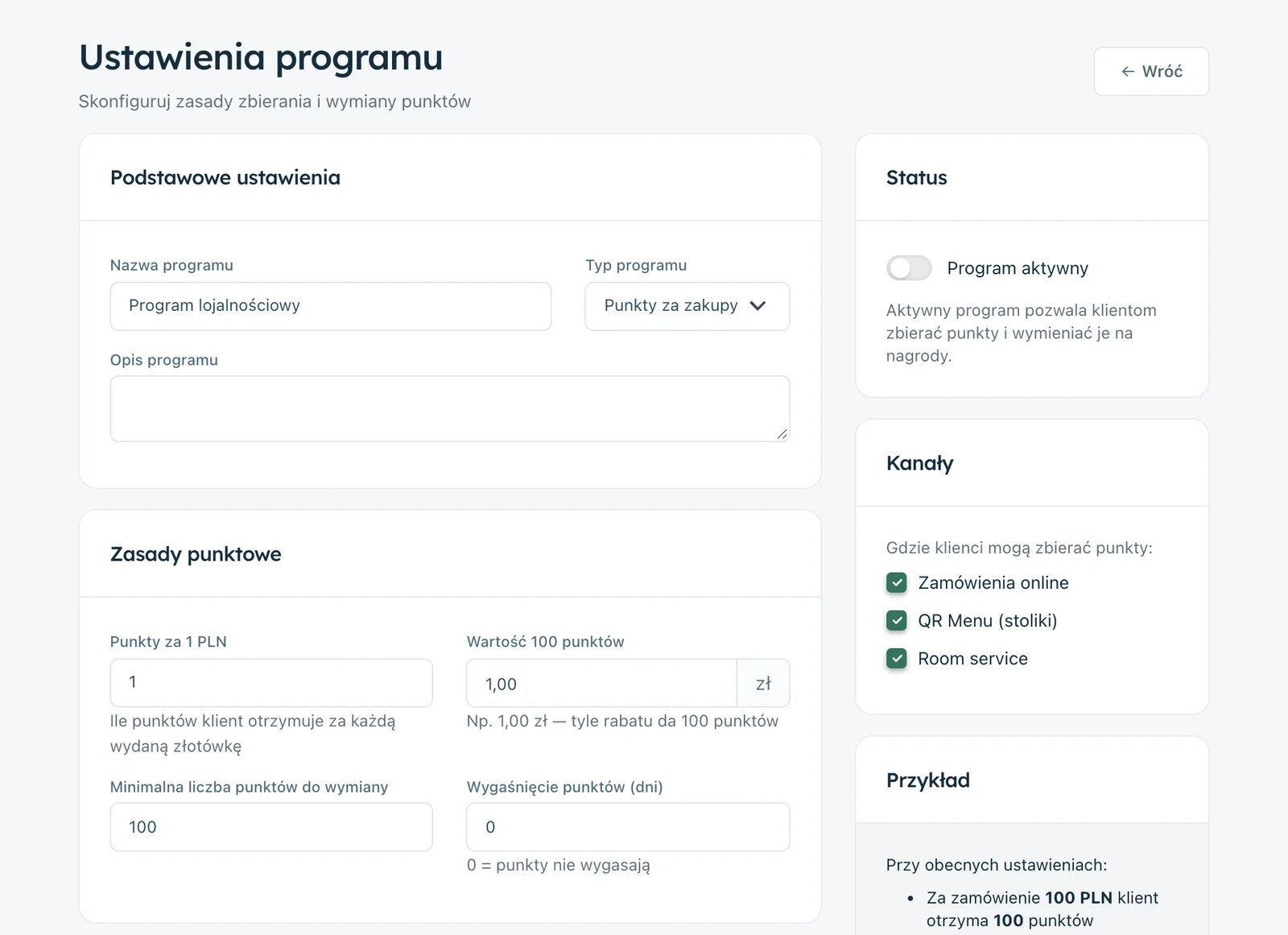
In Ranedo, the loyalty programme is available in the Plus and Pro plans. Points for orders can be awarded automatically, and the restaurant defines its own rewards catalogue.
Reward redemption is recorded by staff in the customer's profile. Customers do not redeem points themselves in an app. Points can also be added or deducted manually, for example when a correction is required.
The programme is connected to the CRM customer database. In the Plus and Pro plans, you can view order and visit history, spending, points, notes and tags, create segments and export data. E-mail and SMS campaigns are also available, although SMS messages are charged separately. The system supports e-mail and SMS marketing consent and unsubscribing.
You can find more information about tools for working with your customer database in the customer relationships section.
Start with a simple programme and develop it based on data
You do not need to create ten thresholds, a dozen customer segments and an extensive rewards catalogue from the beginning. It is better to start with a simple mechanism, a few attractive rewards and clear communication.
After a few weeks or months, review how customers behave. If the first reward is too difficult to earn, change the threshold. If everyone chooses only one reward, analyse the catalogue. If the programme generates many sign-ups but few return visits, the problem may lie in the offer rather than in the points themselves.
A loyalty programme should evolve together with the restaurant. The most important thing is that it is easy for customers to understand, financially controlled and based on real data about repeat visits.
Try the loyalty programme in Ranedo
The points programme, rewards catalogue and CRM customer database are available in the Plus and Pro plans. You can view the Ranedo plans or create an account and use the free first month with all features included in your selected plan.
Frequently asked questions
Are points better than stamps?
It depends on the restaurant's business model. Stamps are simpler, while points offer more flexibility and allow you to create different thresholds and a rewards catalogue.
Should a loyalty programme offer a permanent discount?
Not necessarily. Specific rewards such as a product, an extra or free delivery often provide better cost control than a discount on the entire bill.
How often should you analyse the programme?
It is worth regularly reviewing return visits, visit frequency and reward redemption. You do not need to analyse the results every day, but the programme should not run for months without being reviewed.
Does joining the programme mean consent to e-mail and SMS marketing?
You should not assume so. Marketing consent should be handled in accordance with applicable regulations and separately from participation in the programme itself.
Share this article: