Online payments for restaurants — how to choose a provider
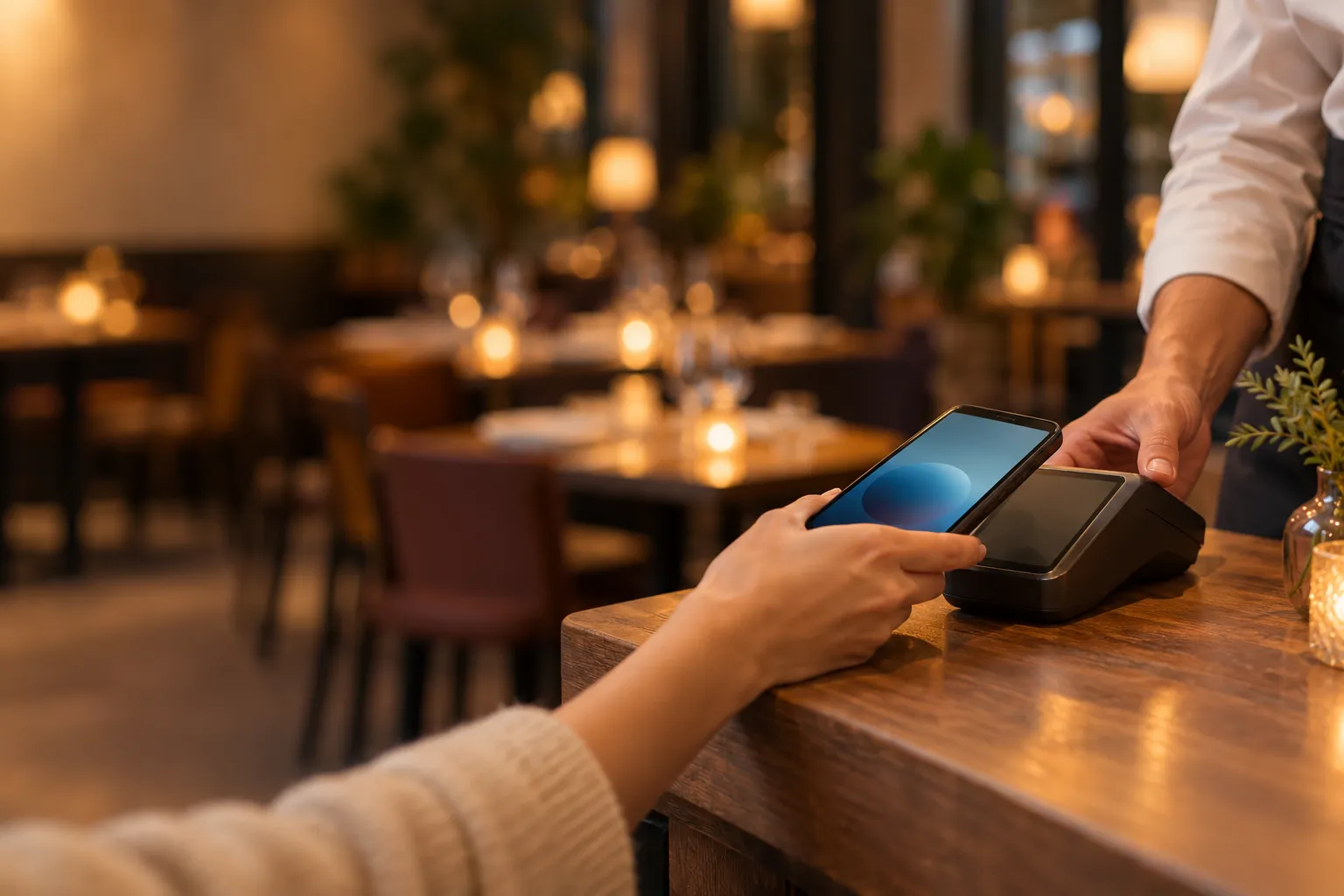
Online payments have become a natural part of delivery and collection orders. For customers, convenience matters most: they want to pay by BLIK, card or instant bank transfer and receive an order confirmation straight away. For a restaurant, however, choosing a payment provider is more complex, because you need to consider not only transaction fees but also how funds are paid out, how refunds work, business verification and support when problems occur.
Popular payment providers in Poland include Tpay, Przelewy24 and PayU. It is not worth choosing solely on the basis of one figure from a price list. Terms can change, and if you process a higher volume of payments, you can often ask for an individual offer.
Do not compare payment providers solely by transaction fees
The transaction fee is important, but it is not always the most important factor. A difference in the rate may matter less than problems with payouts, a complicated refund process or the absence of a convenient payment method for your customers.
When choosing a provider, it is worth checking the entire process:
- how much each transaction costs,
- whether there are fixed fees,
- which payment methods are available,
- how quickly funds reach the restaurant's bank account,
- how refunds are processed,
- what is required to activate the account,
- whether a test mode is available,
- how support works when something goes wrong.
Always check current rates directly in the provider's pricing information. If you receive a large number of online orders, it is also worth asking whether the terms can be negotiated.
1. Transaction fees and additional charges
The most obvious cost is the fee charged on each payment. However, do not assume that one figure describes the full cost of using the service.
Before signing a contract, check:
- whether the fee is percentage-based, a fixed amount or a combination of both,
- whether the terms vary depending on the payment method,
- whether there is an activation fee or subscription fee,
- whether refunds involve additional charges,
- whether payouts are subject to additional fees,
- whether promotional terms apply only for a limited period.
Example: assume one offer has a lower transaction fee but charges extra for certain operations. Another has a higher basic rate but a simpler pricing structure. Only after calculating your own number of orders and average transaction value can you assess which option is more favourable.
2. BLIK, cards and instant bank transfers
The provider should support the payment methods your customers actually want to use. For orders placed on a phone, it is particularly important to make payment quick without requiring customers to enter large amounts of information.
It is worth checking the availability of:
- BLIK,
- payment cards,
- instant bank transfers,
- other methods offered by the provider if they are relevant to your customers.
The aim is not to offer as many payment methods as possible. It is more important that the essential methods work well on smartphones and do not create problems at the final stage of the ordering process.
If a customer chooses their dishes, enters their address and only discovers at the final step that they cannot pay using their preferred method, they may abandon the order. You can read more about these issues in the article about improving the online ordering process.
3. Payout times
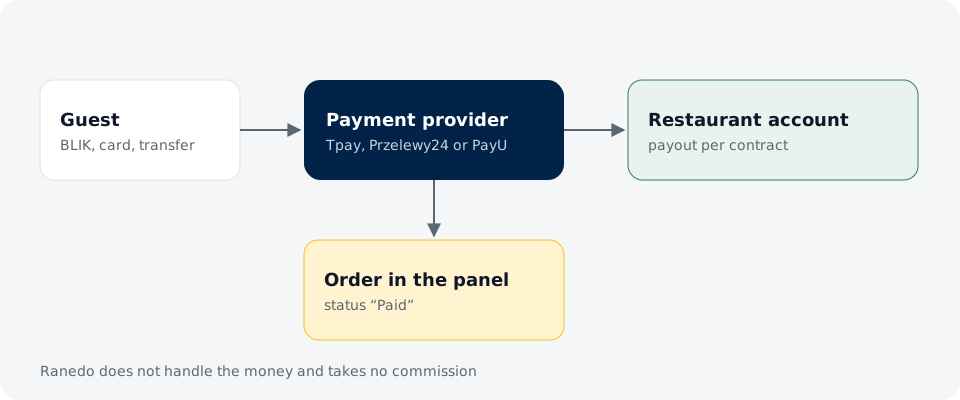
The customer pays the payment provider, but from the restaurant's point of view, what matters is when the money reaches its bank account.
Before choosing a provider, ask:
- how often payouts are made,
- whether the payout schedule can be changed,
- whether there is a minimum payout amount,
- how weekends and public holidays are handled,
- whether payouts are automatic.
This is particularly important when a large proportion of your sales is processed through online payments. A restaurant regularly has to pay for supplies, wages and day-to-day operating costs, so predictable cash flow matters.
4. Refunds should be simple for staff
A payment refund may be necessary when the restaurant cannot fulfil an order, the customer and restaurant agree to cancel it, or another situation requires the money to be returned.
It is worth checking the entire process in advance rather than learning how it works for the first time during a problem on Friday evening.
Ask the provider:
- how to initiate a refund,
- whether partial refunds are possible,
- how long refund processing takes,
- whether there is an additional charge for refunds,
- what happens to the fee charged on the original payment,
- where you can check the refund status.
What should you do when an order is cancelled?
First, make sure the payment was actually collected. Then issue the refund according to the provider's procedure and inform the customer that the process has started.
Do not promise an exact time when the money will appear in the customer's account if you do not control that process. The posting time may depend on the payment provider, the bank and the payment method used.
5. Test mode and checking the integration
It is best to test payments before opening online ordering to customers. A provider may offer a test environment, often called a sandbox, where you can check the integration without making a real payment.
It is worth testing, among other things:
- a successful payment,
- an interrupted payment,
- a declined transaction,
- the customer's return to the restaurant website,
- correctly matching the payment to the order,
- the refund process.
The fact that the provider account is active does not mean the entire ordering process is working correctly. Testing should cover the full journey from adding a dish to the basket through to payment confirmation.
6. Documents and restaurant verification
The payment provider needs to verify the business before enabling full transaction processing. The information required may depend on the provider, the legal form of the business and its current procedures.
Before starting the integration, check which documents will be required. These may include information about:
- the business,
- people authorised to represent it,
- the bank account,
- the website and terms and conditions,
- the nature of the business.
Do not leave this until the day you plan to launch online ordering. Verification may require additional information or changes to information on your website.
7. Customer support only becomes important when something goes wrong
During normal operation, you will probably contact the payment provider rarely. Problems arise when some payments stop working, a transaction has an unclear status or you need to clarify a refund.
Before signing a contract, check:
- which channels you can use to report a problem,
- what hours support is available,
- whether technical documentation is available,
- where you can check service status,
- how to report a problem with a specific transaction.
If most of your online orders are placed in the evenings and at weekends, pay particular attention to support availability during those hours.
Table: what to check before choosing a payment provider
| Criterion | What to look for | Question to ask the provider |
|---|---|---|
| Transaction fee | Percentage fee, fixed charges, additional costs | What will the total cost of processing my typical transactions be? |
| BLIK | Availability and how it works on a phone | Is BLIK included in the standard offer? |
| Cards | Supported card types and the mobile payment process | How does card payment work on a smartphone? |
| Instant bank transfers | List of supported banks and convenience of the process | Which banks are currently supported? |
| Payouts | Frequency and rules for transferring funds | When does the money from transactions reach my account? |
| Refunds | Full and partial refunds, costs, status | How do I issue a refund and is there an additional charge? |
| Test mode | Ability to check the integration before launch | Do you provide a sandbox or another test environment? |
| Verification | Documents and website requirements | What do I need to prepare to activate payments? |
| Support | Contact channels and support availability | How do I report an urgent payment problem? |
| Individual offer | Possibility of negotiating terms at higher turnover levels | At what turnover level can you offer individual terms? |
Should you still allow cash on collection?
Offering online payments does not mean you have to stop accepting cash completely. Some customers may still prefer to pay on collection or delivery.
Cash has several advantages:
- it does not require going through a payment provider,
- every customer understands how it works,
- it can provide an alternative when there is a problem with online payments.
However, it also has one important disadvantage: the restaurant starts preparing the food before receiving payment.
The risk of uncollected orders
With online payment, an uncollected order is still an operational problem, but the restaurant has confirmed payment. With cash, the restaurant may also be left with the full cost of preparing the food.
To reduce the risk, you can introduce your own rules, for example:
- require online payment for larger orders,
- confirm unusually large orders by phone,
- watch for repeated problematic orders,
- clearly state the collection time and method.
However, do not make the process more complicated for every customer because of isolated cases. First check whether uncollected orders are actually a problem in your restaurant.
Payment should not become a separate operational problem
From the customer's point of view, payment is simply one of the final steps in placing an order. They should not have to wonder whether the restaurant received the money or whether they need to send proof of payment.
The ordering system should receive information from the payment provider and match it to the relevant order. This allows staff to see the correct status instead of manually comparing the list of payments with the list of orders.
How do payments work in Ranedo?
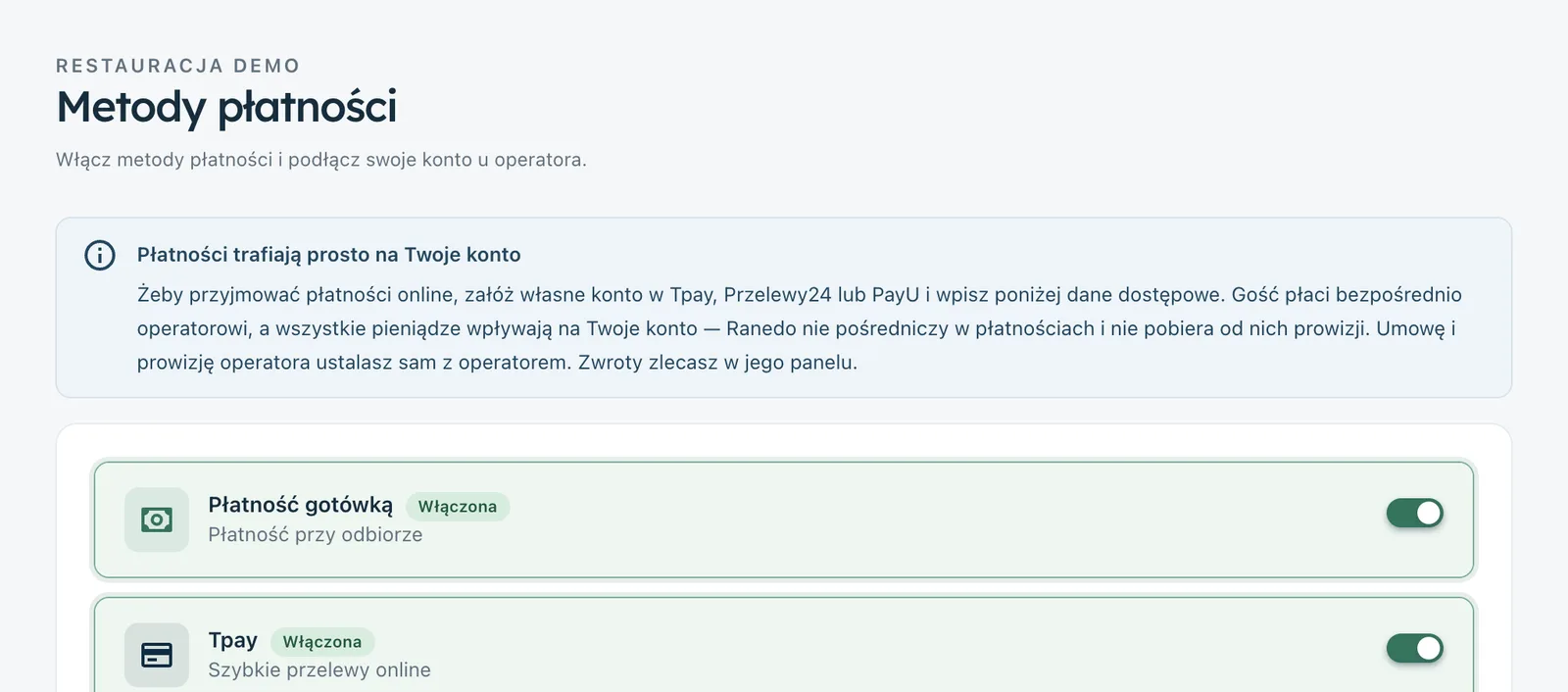
In all Ranedo plans, restaurants can accept cash on collection as well as online payments through Tpay, Przelewy24 or PayU.
The restaurant signs the contract with the payment provider. The customer pays the provider, and the money reaches the restaurant's bank account according to the terms agreed with the selected company. Ranedo does not charge commission on payments or orders.
In the configuration, you can test the connection with the provider and use test mode. This allows you to check whether the integration works correctly before you start accepting real orders.
If an order is cancelled and a refund is required, the refund can be initiated from the specific order in Ranedo. The payment process is then handled by the payment provider.
You can find more information about online sales features in the online ordering in Ranedo section.
Your own payments help you retain control over orders
If you operate your own sales channel, the contract with the payment provider belongs directly to your restaurant. You can compare offers and negotiate terms depending on your turnover.
This differs from a model in which all sales go through an external delivery platform. You can read more about this difference in the article about delivery platform commissions and your own online ordering.
This does not mean you always have to stop using intermediaries. The point is to understand the cost of each channel and consciously decide which orders you want to direct through your own website.
How do you choose a payment provider in practice?
Before making a decision, prepare a simple list of requirements. For most small restaurants, it might look like this:
- Check whether the provider supports BLIK, cards and the instant bank transfers you need.
- Compare current pricing and all additional charges.
- Ask how often funds are paid out.
- Check the procedure for full and partial refunds.
- Find out which documents are required for verification.
- Check whether you can test the integration before launch.
- Test the payment process on a phone.
- Check support availability during the hours when your restaurant receives the most orders.
- If you have higher turnover, ask about individual terms.
Only after this comparison should you choose an offer. The lowest transaction fee shown at the top of a price list does not necessarily mean the best solution for your restaurant.
Try online payments together with online ordering
Integrations with Tpay, Przelewy24 and PayU, as well as cash on collection, are available in all Ranedo plans. You can check the available plans or create an account and use the free first month with all features included in your selected plan.
Frequently asked questions
Which payment provider is the cheapest?
There is no single answer that applies to every restaurant. Providers' pricing and promotions can change, so compare the current terms offered by Tpay, Przelewy24 and PayU. If you have higher turnover, it is also worth asking about an individual offer.
Is it worth offering both online payment and cash?
It can make sense if some of your customers still prefer cash. However, you need to take into account the higher risk of an order not being collected when the restaurant has not received payment in advance.
What happens to the money when a customer pays through Ranedo?
The customer pays through the selected payment provider, and the funds reach the restaurant's bank account according to the agreement with Tpay, Przelewy24 or PayU. Ranedo does not charge commission on payments.
Can payments be tested before online ordering is launched?
Yes. Ranedo allows you to test the connection and use test mode, so you can check the configuration before you start accepting real payments.
How do I issue a refund for a cancelled order?
In Ranedo, a refund can be initiated from the order. Further refund processing is handled by the payment provider according to its rules and processing times.
Share this article: