Online sales
Delivery portal commissions vs. your own online orders
Delivery portal commissions grow along with your sales. See how to build your own online ordering channel without giving up the portals.
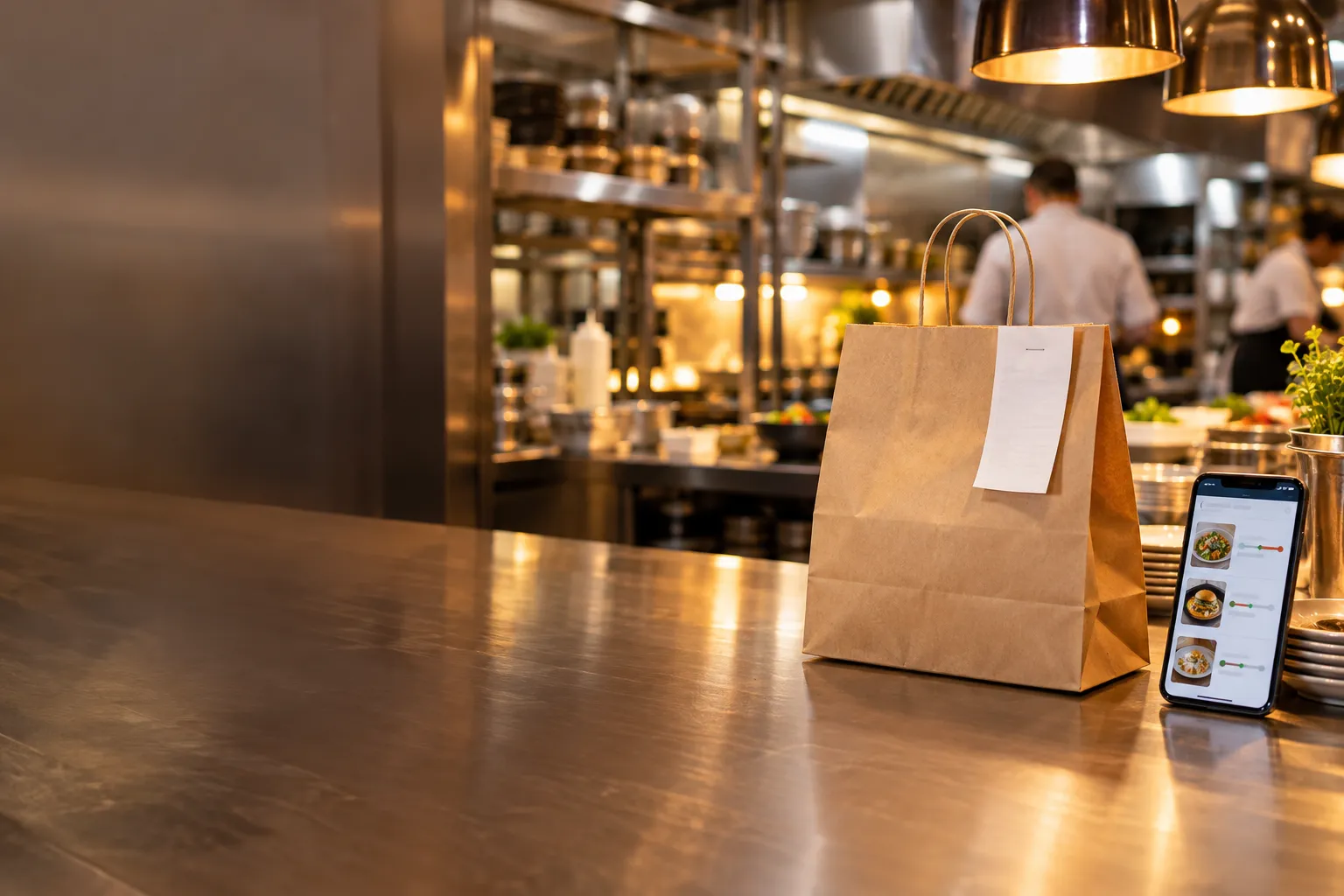
Delivery portals can be a good source of new orders. A guest opens the app, browses restaurants nearby, and may come across a venue they didn't know before. The problem starts when a large share of regular customers still order through the intermediary, even though they already know your restaurant.
In this model, a commission may be charged on every order, according to the terms of the specific portal. At the same time, the relationship with the guest mostly stays inside the platform. Your restaurant is one of many items on a list and has limited ability to build its own customer base.
This does not mean you have to drop portals right away. A more practical approach is to use them to win new guests while you also grow your own ordering channel for people who already know your venue.
The problem: commission grows with sales
In a commission model, the cost of the channel is directly tied to the value of the orders it handles. The more you sell through an intermediary, the higher the total commission can be.
We do not give the rates of specific portals here, because their price lists, packages and terms can change. Before you decide, check your current contract and work out your real cost.
A sample calculation
Let's say a restaurant fulfills through a portal 600 orders a month, and the average order value is PLN 70.
Total sales through this channel are then:
600 × PLN 70 = PLN 42,000 per month
Let's also assume, for the sake of example only, that the total commission cost of this channel equals 20% of sales value.
PLN 42,000 × 20% = PLN 8,400
In this example scenario, the channel costs PLN 8,400 per month.
This does not mean every portal charges that commission. It is only an example showing the mechanism: with a percentage model, cost grows along with turnover.
For comparison, your own ordering system can run on a subscription model. Then the cost of the system itself does not grow in proportion to the number of orders. We charge no commission on the orders themselves, and the percentage fee applies only to online payments.
The second cost: your regular guest still comes back through the intermediary
A portal is most valuable when it helps you reach someone who does not know your restaurant yet. From an economic point of view, it can be less favorable when the same guest orders only through the intermediary app month after month.
Picture a simple scenario. Someone finds your pizzeria on a portal for the first time, orders, likes the food, and a week later wants to order again. If the only channel they know is the intermediary's app, they will most likely go back there.
If, on the other hand, they get a note with the order saying they can order directly on the restaurant's website next time, you give them an alternative.
It is not about forcing guests to change their habits. It is about making sure they know your own channel exists at all.
The third problem: the guest database stays outside your restaurant
Your own sales channel lets you build a direct relationship with the people who buy from your venue. With orders placed only through an intermediary, the data available to the restaurant depends on the rules of the specific platform.
This matters, because your own database can later be used for things like:
- analyzing order history,
- recognizing regular guests,
- running a loyalty program,
- creating customer segments,
- running e-mail or SMS campaigns once you have the right consents.
If you do not build your own database, then for every new campaign you have to reach the guest again through an external channel.
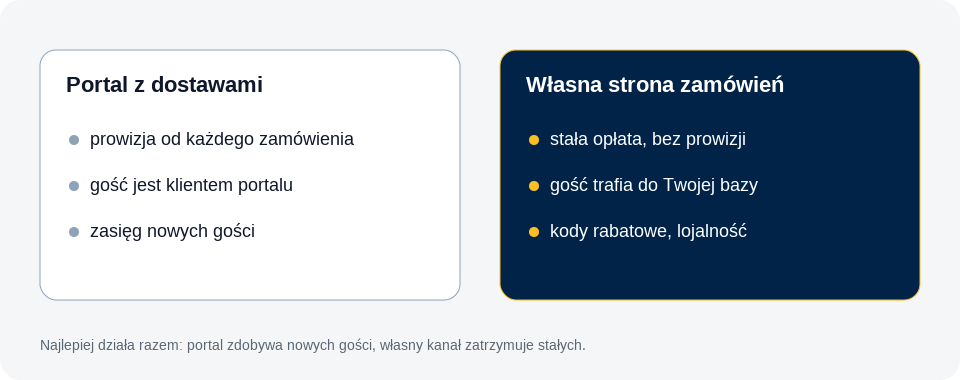
On a portal, you compete on one list with other venues
A guest using an intermediary app usually sees many restaurants side by side. They can compare cuisines, prices, promotions, delivery times and other parts of the offer.
Even if they were just looking at your menu, a few seconds later they can move on to another venue.
On your own website, the situation is different. Someone who has come to your restaurant's address is already in your brand's environment. There are no dozens of competing venues shown next to you by the same platform.
This does not mean your own website will automatically beat a portal. You still need to send traffic to it and make ordering convenient.
If your own cart is unclear or payment takes too long, the guest may go back to the app they know. That is why it is also worth looking at how to improve the online ordering process in a restaurant.
Does that mean you have to give up portals?
No. In many venues, a strategy of gradually building your own channel makes more sense than suddenly switching off the intermediaries.
A portal can give you access to people who:
- do not know the restaurant yet,
- are looking for food in a specific area,
- are comparing several venues,
- would not have found your website directly.
So you can treat a portal as one channel for winning new guests, and your own website as the place where you send people who already know your venue.
How to gradually move regular guests to your own channel
The best moment is right after the guest has picked up the order and is happy with their purchase. You do not need an aggressive campaign. It is enough to keep telling them they can order directly next time.
Add a flyer to the bag
You can include a simple card with every order, with your website address and a short message:
Next time you can order directly on our website.
The address or QR code should be the main thing. Do not fill the flyer with a dozen messages.
Put a QR code on the packaging
If you use your own boxes, stickers or paper bags, you can add a QR code that leads straight to your online menu.
The guest then does not have to remember the website address. Next time, they just scan the code.
Give a benefit for the first direct order
You can offer a discount code, free delivery or a free item with the first order on your own website. First, though, work out what the promotion costs.
Suppose a one-off perk costs you PLN 8. If it later leads a regular guest to use your own ordering channel, you can compare the cost of the one-off action with the cost of continued service through an intermediary.
Do not assume, however, that every guest will stay in your own channel. Calculate the promotion so that it still makes sense when some people use it only once.
Send Google and social media traffic to your own website
If someone types your restaurant's name into a search engine or visits your venue's social media profile, they probably already know you.
In such a place, it is worth pointing the “Order” button straight to your own website, not automatically to an intermediary.
A portal can win new guests. Your own communication channels, on the other hand, are worth using to lead people who are already interested in the restaurant to order directly.
Your own channel needs your own delivery organization
With direct orders, you have to decide where you actually deliver and on what terms. It is not enough to put “delivery within the city” on the website.
It is worth defining:
- the delivery area,
- the delivery cost,
- a minimum order value,
- the fulfillment time for each area,
- the hours when you accept orders.
Example: delivery two kilometers from the venue can be profitable with a smaller order than delivery to the other side of the city. Instead of one rule for all addresses, you can divide the area into zones.
You can read more about this model in the article on delivery zones and minimum order amount.
Should prices on a portal and on your own website be the same?
This is a business decision for the restaurant and should take into account the terms of your contracts with the platforms you use. Do not change prices in individual channels without first checking the cooperation rules in force.
From an economic point of view, though, it is worth calculating the real cost of selling in each channel.
With your own orders, you may have:
- a subscription for the system,
- an online payment fee (in Ranedo, depending on the plan, from 1.09% to 1.98% plus PLN 0.39 per payment),
- payment provider fees,
- the cost of your own delivery,
- the cost of promotion and marketing.
With a portal, there are the financial terms agreed with the intermediary. So compare the total cost of handling an order, not just one item.
How do you work out whether your own channel makes sense?
Start with real data from the last month.
- Check the number of orders through the portal.
- Work out their total value.
- Check the real costs under your contract with the portal.
- Work out the payment provider cost in your own channel.
- Add the cost of the system for online orders.
- If you deliver yourself, also work out the cost of delivery.
Then prepare a few scenarios. Do not assume right away that you will move all orders.
Let's say you currently have 600 orders through an intermediary. You can work out what the result would look like if 50, 100 or 200 orders a month went through your own website.
This approach gives you a much more realistic picture than assuming all traffic will move to the new website overnight.
How does your own channel work in Ranedo?
Ranedo is a system for building your restaurant's own ordering channel. It is not an aggregator of orders from portals and does not integrate with delivery portals.
All Ranedo plans come with a fixed subscription. We charge no commission on the orders themselves. The fee applies only to online payments: 1.98% on the Start plan, 1.49% on the Plus plan and 1.09% on the Pro plan, always plus PLN 0.39 per payment. The Start plan includes up to 79 orders in each month of the billing period, and the Plus and Pro plans have no order limit.
The Start plan costs PLN 79 net per month and includes, among other things, your restaurant's own website with online ordering, a menu, pickup and delivery, and delivery zones.
Tpay handles online payments: BLIK, fast bank transfers, and cards. The restaurant signs the agreement with the provider, and the payment money goes to its account under that provider's terms.
Delivery zones in your own channel
In Ranedo, you can define the delivery area as a radius from the venue, an area drawn on a map, or postal codes. For each zone you can set separately:
- delivery price,
- minimum order amount,
- delivery time.
The address the guest enters is checked automatically.
Plus: your own channel also starts building a guest database
In the Plus and Pro plans Ranedo offers extra tools that help you move regular guests to direct sales.
You can create:
- discount codes,
- percentage and fixed-amount discounts,
- free delivery,
- free items,
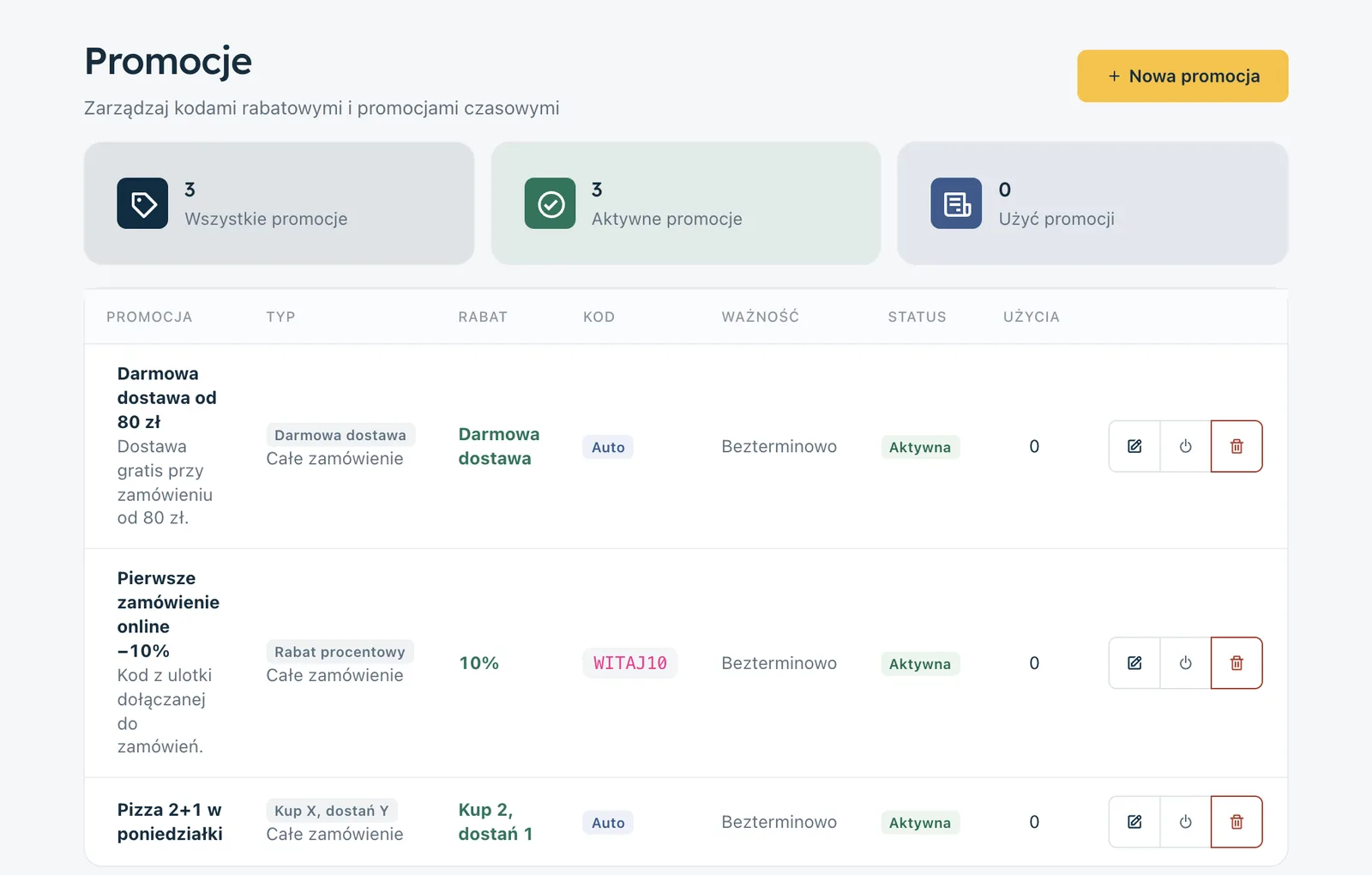
- “buy X, get Y” promotions,
- a loyalty program.
These plans also include a CRM guest database with order and appointment history, spending, points, notes, tags and segments.
Once you have the right consents, you can run e-mail and SMS campaigns. SMS messages are billed separately.
Plus and Pro also let you connect your own domain, for example www.yourvenue.com, instead of using only an address on a Ranedo subdomain.
The best model does not have to mean choosing just one channel
A portal and your own website can serve two different purposes.
A portal can help you win new guests. Its users browse many restaurants and may discover your venue for the first time.
Your own website lets you build a direct channel for people who already know you. You can also grow your own guest database.
In practice, a sensible strategy might look like this:
- keep the portal as a source of new customers,
- launch your own ordering website,
- add its address to packaging and materials in the venue,
- send traffic to it from search and social media,
- encourage regular guests to order directly,
- regularly compare the number and cost of orders in both channels.
So you do not have to make an “either portal or own website” decision. You can change the proportions gradually and see which channel best fills a specific role.
Build your own ordering channel with Ranedo
Ranedo runs on a subscription: we charge no commission on the orders themselves, and the fee applies only to online payments (1.09% to 1.98% plus PLN 0.39, depending on the plan). Orders paid in cash or on pickup carry no fee at all. Already on the Start plan for PLN 79 net per month you can launch your own site with a menu, online ordering, payments and delivery zones. The Plus and Pro plans add promotions, discount codes, a CRM and a loyalty program, among other things.
Check the plans or Ranedo plans or create an account and use the first month free, with all the features of the plan you choose.
Frequently asked questions
Does having my own online orders mean I should drop portals?
No. A portal can still be used to win new guests. You can grow your own channel in parallel, especially among people who already know the restaurant.
How much commission do delivery portals charge?
The terms depend on the specific platform, contract and scope of services. Check the current price list and your contract instead of basing your decision on general rates you find online.
Will orders from portals show up in Ranedo?
No. Ranedo does not integrate with delivery portals. It is a solution for running a restaurant's own sales channel, not an aggregator of orders from outside platforms.
```