Marketing
Restaurant promotions that don't eat your margin
Restaurant promotions without a constant 20% discount? See how to set up freebies, codes, free delivery and sets without hurting your margin.
A promotion in a restaurant shouldn't automatically mean "20% off everything". Such a discount is easy to launch, but it can just as easily lower the margin on orders the guest would have placed without a discount anyway. If it appears regularly, some customers may also start putting off a purchase and waiting for the next campaign.
A better promotion has a specific goal: fill slower hours, encourage a first order through your own site, increase basket value, promote a new dish, or get the guest to choose a set instead of a single item.
So first decide what you want to change. Only then choose a discount, a freebie, or a code.
Why a discount on everything is tempting but risky
A fixed percentage discount is easy to communicate. The guest sees a simple message, and the restaurant doesn't have to build complicated rules.
The problem is that the discount lowers the value of the whole order, including when the customer would have bought the product at the normal price anyway.
If the promotion covers the whole menu, it can also:
- lower the margin on the best-selling dishes,
- make it harder to judge whether an order really came from the promotion,
- get guests used to buying only with a discount,
- make the promotion work during the busiest hours too, when you don't need extra demand.
That's why before every campaign it is worth setting not only the size of the discount but also the scope, time, channel, and condition for using it.
Start with the goal of the promotion
A promotion without a goal is simply a price cut. A promotion with a goal can be a tool for steering specific guest behavior.
Filling slower hours
If between 2:00 PM and 4:00 PM you have many free tables or few online orders, you can prepare an offer available only at that time.
There is then no reason for the same discount to apply on Friday at 7:00 PM, when the kitchen is at full load.
Moving guests to your own channel
You can prepare a code meant only for the first order through your own site.
Such a code has a specific purpose: to encourage someone who already knows the venue to use the direct channel next time.
You can read more about this approach in the article on portal commissions and your own online orders.
Increasing basket value
Instead of an unconditional discount, you can tie the promotion to a minimum order value.
Example: the guest gets free delivery or a free product after passing a certain threshold. The promotion then encourages a bigger basket instead of just lowering the price of products already chosen.
Promoting a new dish
If you introduce a new item, you can use a promotion to encourage guests to try it.
You don't have to discount the whole menu. You can build a set or add a specific product as a bonus once a condition is met.
A freebie can cost less than a discount of the same value to the guest
It is worth distinguishing the selling price of a product from its cost to the restaurant.
A guest may value highly a product that costs the venue much less than its menu price. That way a freebie can be attractive and at the same time cheaper than a discount on the whole order.
A sample calculation
Suppose, purely as an example, that the average order is PLN 55.
The restaurant wants to encourage the guest to go over PLN 70 and offers a freebie once that threshold is reached.
Suppose that:
- the free product costs the restaurant PLN 4,
- the guest increases the basket from PLN 55 to PLN 72 to meet the condition.
The basket value in this example grew by:
PLN 72 - PLN 55 = PLN 17
The cost of the bonus is, say, PLN 4.
Of course, this doesn't automatically mean PLN 13 of extra profit, because the additional products also carry ingredient and labor costs. The calculation does show, however, why it is worth comparing the cost of a specific reward with a discount on the whole order.
If, instead of the freebie, a large percentage discount were applied to the whole PLN 72, the cut could cost the restaurant more.
"Buy X, get Y" works well on specific products
A mechanic like "2+1" or "buy X, get Y" gives more control than a discount on everything.
You can use it, for example, for:
- selling a third drink when two are ordered,
- adding a specific product to a set,
- supporting a selected category,
- promoting an item that goes well with the main dish.
The key is to calculate the cost of the products covered by the promotion.
If the freebie is the most expensive item in the category, the promotion can look completely different financially than when the discount applies to the cheapest one.
Watch out for multiple application
With a "buy X, get Y" mechanic, decide what happens with a larger order.
If a guest buys six products, should the promotion apply once or twice? Both options can be right, but they should be set deliberately.
It is also worth setting a maximum number of uses per order.
Free delivery should have a condition
Free delivery sounds good in marketing, but for the restaurant delivery still generates a cost. Someone has to spend time, use fuel, and deliver the order.
That's why it is better to tie free delivery to:
- a minimum basket value,
- a specific code,
- a set time period,
- a selected sales channel.
Example: instead of offering free delivery on every order, you can set it only from the amount at which the delivery economics make sense for you.
Discount codes help measure the source of a promotion
A code isn't only for giving a discount. It can also be a simple tool for checking where an order came from.
You can prepare different codes for:
- a flyer slipped into the bag,
- an e-mail campaign,
- social media,
- a specific ad,
- a campaign aimed at a selected group of guests.
If the code from one flyer is used regularly and another hardly at all, you have more information about how well your efforts work.
This doesn't mean a code gives a full picture of marketing. Some people will see the ad but order later without a code. Even so, the number of uses is far more useful than no measurement at all.
Set an expiry date and limits
A promotion should have a start and an end. If it runs indefinitely, it can quickly become the normal price in guests' eyes.
It is worth setting:
- a start date,
- an end date,
- a minimum order value,
- a maximum discount value,
- a total usage limit,
- a usage limit per customer.
Example: a first-order code shouldn't be usable by the same person endlessly.
Likewise, a one-off weekend campaign shouldn't accidentally stay active for months.
Lunch sets let you steer the offer without discounting the whole menu
A set can be more predictable in cost than a percentage discount.
Example: between 11:00 AM and 3:00 PM you can offer a specific lunch set made of a main dish and a side at a fixed price.
You then control:
- the products in the set,
- the cost of ingredients,
- the hours of availability,
- the price of the whole package.
You can also design the set to use ingredients that are already in the regular menu.
That way you don't have to discount the whole offer just to increase lunchtime traffic.
Promotions can work only in selected channels
Not every campaign should work everywhere.
Example: if the goal is to move guests to your own online orders, there is no point giving the same code with every other way of buying.
You may also want to prepare a separate promotion for:
- orders from the website,
- QR orders at the table,
- orders from hotel rooms, if you use such a channel.
The choice of channel should follow from the goal of the promotion, not from a "the same everywhere" rule.
One promotion at a time is often better than stacking discounts
If several promotions can combine in one basket, it is easy to lose control of the final price.
Example: the guest gets a percentage discount, a free product, free delivery, and an extra code. Each element may look reasonable on its own, but together they can make the order unprofitable.
A simpler rule is to apply one promotion per order.
Then it is easier to:
- calculate the cost,
- explain the rules to the guest,
- assess how well the campaign worked,
- avoid unexpected stacking of discounts.
How do you measure whether a promotion works?
The number of codes used alone doesn't answer every question. It is worth looking at several things at once.
Compare:
- the number of promotion uses,
- the average order value with the promotion,
- the cost of the discounts and freebies given,
- the channel the orders came from,
- the hours orders were placed,
- whether guests come back later without a promotion.
Example: a campaign may have generated many orders, but if most fell on Friday evening, when the venue was full anyway, its value may be lower than that of a promotion that triggers extra orders on a quiet Tuesday.
Typical mistakes with restaurant promotions
A discount with no defined goal
If the only reason is "we have to run a promotion", it is hard to judge its effectiveness later.
Too high a discount on the whole menu
The biggest discount isn't necessarily the most attractive business solution. It is often better to offer a specific freebie or a set.
No limit
A publicly posted code can be used more times than you planned. Set limits if the promotion budget is meant to be controlled.
A promotion during peak hours
If the kitchen already can't keep up, an extra discount can only lengthen the queue and the fulfillment time.
Rules that are too complicated
If an employee needs a few minutes to explain the promotion terms, the guest will probably also have trouble understanding the offer.
Constantly handing out discounts to regulars
You can reward regular customers differently than by endlessly lowering every bill. One option is a points program and a catalog of specific rewards.
You can find more about this model in the article on the loyalty program in a restaurant.
How do promotions work in Ranedo?
Promotions are available in the following plans Plus and Pro plans.
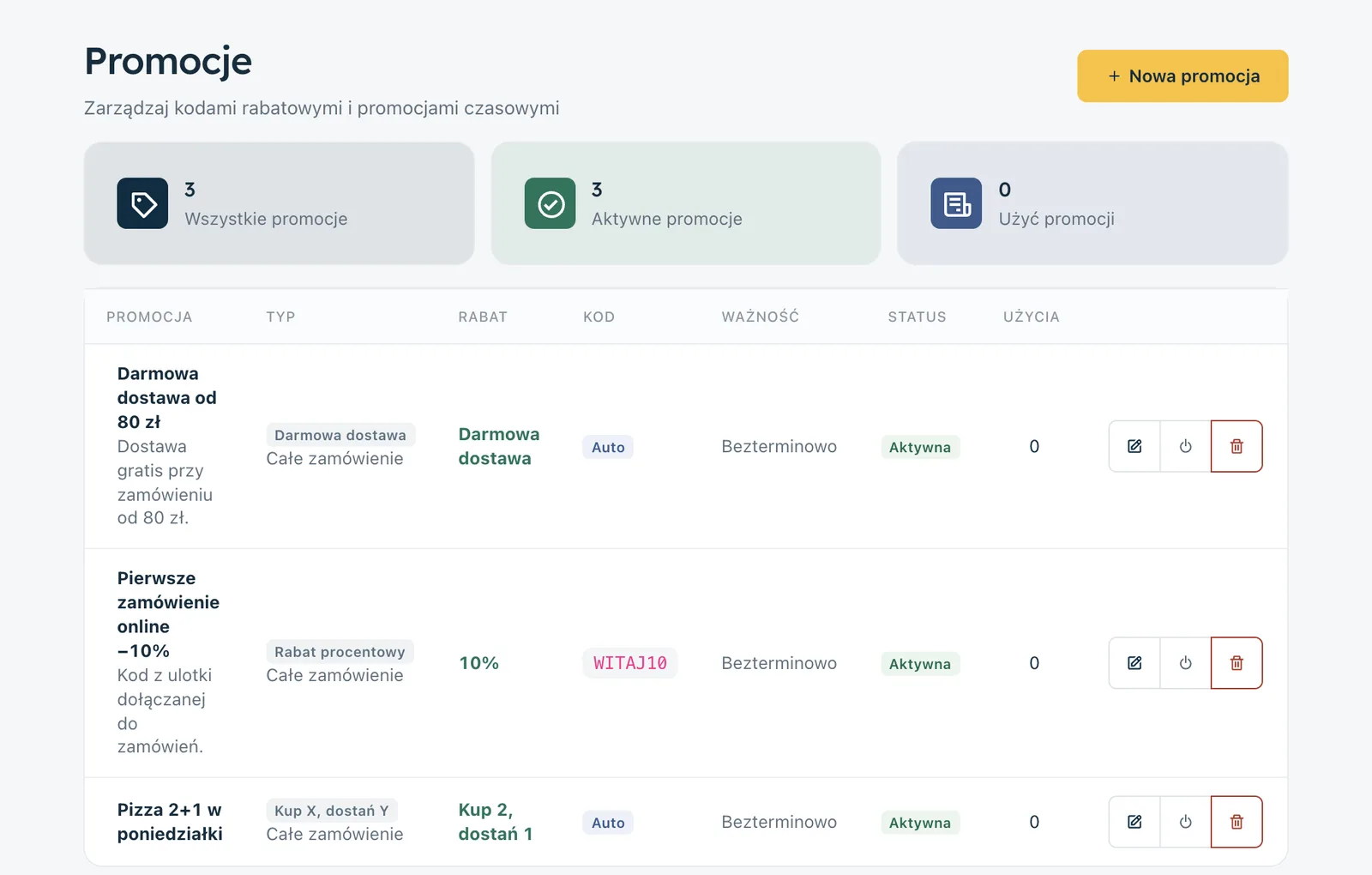
You can create, among other things:
- a percentage discount,
- a fixed-amount discount,
- free delivery,
- a free product once a condition is met,
- a "buy X, get Y" promotion,
- dish sets at a promotional price.
A promotion can work automatically or require the guest to enter a code.
Terms and limits
During setup you can specify, among other things:
- a minimum order value,
- a maximum discount value,
- a total usage limit,
- a usage limit per customer,
- a validity period from a specific date to a specific date.
That way a promotion doesn't have to be open-ended or available without restrictions.
The "buy X, get Y" promotion
You can set up a mechanic like 2+1 or another variant based on the number of products.
The system can apply the discount to the appropriate items, for example the cheapest ones. The mechanism can also apply multiple times if the conditions are met, and you can limit the number of applications.
Selected channels
Promotions can be directed to selected sales channels, such as:
- online orders from the website,
- QR orders from tables,
- room service in the Pro plan.
Promotions don't work on the waiter screen. If a waiter enters an order directly on their screen, you shouldn't expect the promotion available on the website or in the QR menu to be applied automatically.
What if several promotions fit an order?
In Ranedo, one promotion is applied per order.
If an order meets the conditions of several active campaigns, the system chooses the one most favorable to the guest.
That way discounts don't stack on top of each other, and the final price is easier to control.
Sets can work only at certain hours
Promotional sets can be used to create an offer available at specific hours.
Example: a lunch set can be available from 11:00 AM to 3:00 PM, and outside that window the regular dishes are still sold separately.
This lets you prepare an offer matched to a specific time of day without changing the prices of the whole menu.
Counters help you control promotion usage
Ranedo keeps counters of promotion uses. So you can check whether a code or campaign is actually being used.
Combined with limits, this lets you end a promotion once the planned number of uses is reached instead of leaving it active without control.
You can send a code to a specific guest segment
In the Plus and Pro plans, the CRM database lets you create guest segments and run e-mail and SMS campaigns.
So you can prepare a discount code for a specific group and tell them about the promotion without sending the same message to everyone.
Example: instead of a public discount for everyone, you can direct a code to guests who haven't placed an order for a while.
SMS campaigns are billed separately.
A simple outline of a good promotion
Before launching a campaign, go through five steps:
- Choose a goal. Decide whether you want a bigger basket, traffic in slow hours, promotion of a new product, or a move to your own channel.
- Calculate the cost. Check the food cost of the freebie, the value of the discount, and any delivery cost.
- Add a condition. Set a minimum order, a specific product, an hour, or a code.
- Set restrictions. Add an expiry date and usage limits.
- Measure the result. When it ends, check the number of uses, order value, and the cost of the campaign.
Don't extend a promotion automatically just because it was popular. First calculate whether it reached its goal and whether the cost was acceptable.
A promotion should change behavior, not just the price
The most useful promotions have a reason to exist. They encourage ordering in a specific channel, a bigger basket, choosing a set, or buying during hours when the restaurant has spare capacity.
If a discount goes to everyone, all day, on every dish, it gets harder and harder to tell it from a simple price cut.
It is better to use promotions less often, but with a clearly defined goal and cost.
Check promotions in Ranedo
In the Plus and Pro plans of Ranedo you can create percentage and fixed-amount discounts, discount codes, free delivery, freebies, "buy X, get Y" promotions, and sets available at selected hours. You can also set limits, dates, and channels where a promotion applies.
Check the plans or Ranedo plans or create an account and use the first month free, with all the features of the plan you choose.
Frequently asked questions
Which is better, a percentage discount or a free product?
It depends on the cost of the products and the goal of the promotion. A freebie with high value for the guest but low cost for the restaurant can be better than a discount on the whole basket.
Can I set free delivery only from a certain amount?
Yes. In the Plus and Pro plans, a free delivery promotion can be combined with conditions, including a minimum order value.
Can several promotions apply at the same time?
No. In Ranedo, one promotion is applied per order. If several fit, the system chooses the one most favorable to the guest.
Do promotions work on an order taken by a waiter?
No. Promotions don't work on the waiter screen. They are intended, among other things, for orders from the website and the QR menu, according to the channels you set.
How can I check whether a discount code was used?
Ranedo keeps counters of promotion usage. You can also set a total usage limit and a limit per customer, which makes it easier to control the campaign.