Marketing
How to build a loyalty program that works in a restaurant
A restaurant loyalty program: points, rewards, communication, and measuring results. See how to design a simple system for a small venue.
A loyalty program in a small restaurant should be easy for the guest to understand and easy for staff to run. If the rules are complicated, the rewards unattractive, and staff forget about the program at the register, even the best system won't help. On the other hand, a program that is too generous can quickly become a costly discount handed out to everyone without control.
It is best to start with one question: what exactly do you want to achieve. Only later choose points, stamps, a rewards catalog, and the way you communicate.
First define the goal of the loyalty program
A loyalty program shouldn't exist just because "the competition has one too". In a small venue it is worth choosing one main goal and basing the program's mechanics on it.
The most common goals are:
- encouraging guests to come back more often,
- increasing the number of direct orders,
- building your own guest base,
- increasing sales of selected products or sets,
- keeping in touch with people who have already visited the venue.
Example: if most new guests come once and don't return, the goal of the program should be the second and third purchase. If you have many regulars but few direct orders, you can focus the program on benefits available when ordering through your own site.
The goal should be specific. "More loyalty" is hard to measure. "More returning guests" or "higher purchase frequency among people enrolled in the program" already gives you a reference point.
Points, stamps, or a fixed discount?
There is no single mechanic that is right for every venue. Each has different advantages and limitations.
Stamps: the simplest model
The classic card of the "buy 9 coffees, get the 10th free" type is easy to understand. There is no need to explain conversion rates or a rewards catalog.
This solution works well where:
- guests often buy a similar product,
- the average transaction value is similar,
- the offer is simple,
- you want to launch the mechanism without elaborate analytics.
The downside of traditional stamps is the small amount of data. You know someone received a reward, but you don't necessarily see their earlier order history, visit frequency, and preferences.
Points: more flexibility
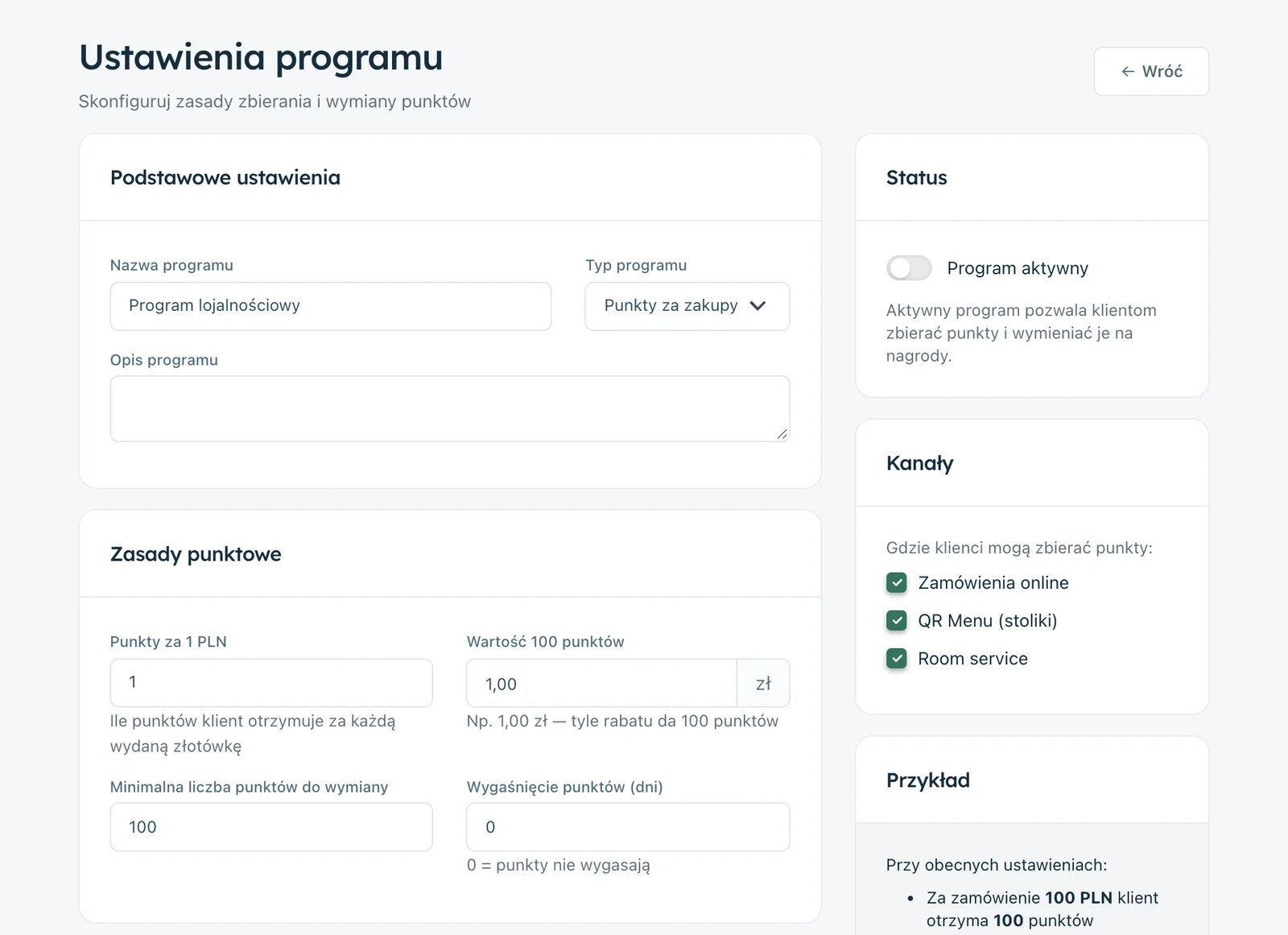
A points program gives more options. The guest collects points for orders and can then redeem them for rewards defined by the restaurant.
This works especially well when you have a wider menu and want to reward different types of purchases. You don't have to limit the program to one coffee, one pizza, or one set.
An example mechanic might look like this:
- points are awarded for each order according to a set rule,
- after reaching a certain level, the guest can receive a chosen reward,
- more expensive or more attractive rewards require more points.
It is important that the conversion rate is simple. If a guest needs a calculator to check whether a reward is worth it, the program is too complicated.
A fixed discount: simple, but easy to overdo
A fixed discount for regular guests is easy to implement, but it has one drawback: it lowers the value of practically every following purchase.
If you give a regular guest a discount on the whole menu at every visit, after a while they may start to treat the reduced price as the normal price. You also lose the ability to steer which products you want to draw attention to.
That's why, for many venues, a catalog of specific rewards works better than a permanent discount on everything.
How to set thresholds so the program is attractive and safe for your margin?
The biggest mistake is setting the first meaningful reward too far away. If a guest has to make a great many purchases before seeing any benefit, they may lose interest in the program.
On the other hand, a reward given too quickly can simply turn into a costly discount.
A good approach is to prepare several levels:
- a small reward reachable relatively quickly,
- a medium reward for guests who come back more often,
- a more attractive reward for the most active customers.
You don't have to create an elaborate catalog right away. In a small venue, a few well-thought-out rewards are usually better than dozens of options nobody remembers.
How to choose rewards?
The best reward isn't always the one with the highest selling price. What matters is the relationship between the cost to the restaurant and the value the guest perceives.
Example: suppose a drink costs PLN 12 on the menu, but its cost to the venue is much lower. For the guest, a "free drink" can be an attractive reward, and for the restaurant the cost is lower than with a PLN 12 discount on the whole order.
The following can work similarly:
- a free dessert,
- an extra ingredient,
- a selected starter,
- free delivery,
- a product from a specific category.
Of course, this depends on your menu and margins. Don't copy another venue's rewards catalog without calculating the costs.
Don't reward everything with the same discount
If the most popular reward is "10% off the whole order", a loyalty program easily turns into a permanent price cut.
It is better to use rewards to promote products that have high value for the guest but don't put excessive strain on the restaurant's costs.
If you want to combine loyalty with time-limited campaigns, the article may also help on promotions and discount codes in a restaurant.
The program must be visible to the guest
Even a good program won't work if nobody knows about it. The information should appear in several places, but without a pushy message at every opportunity.
At the register and during service
Staff should be able to explain the program in one or two sentences.
Instead of a long explanation, a simple message is enough:
When you order from us, you collect points that you can later exchange for selected rewards.
Staff should also know:
- how to check the points balance,
- how to record the redemption of a reward,
- what to do when points were added incorrectly,
- how to answer the guest's basic questions.
On the restaurant's website
The program rules should be described in plain language. The guest shouldn't have to look for basic information in a long set of terms.
It is worth showing on the site:
- how points or rewards are earned,
- what the rewards catalog looks like,
- how they can be used,
- whether points expire,
- whether the program works across every order channel.
If the program is meant to support direct orders, it is worth saying clearly where points are earned. Your own ordering channel can also be a way to reduce dependence on intermediaries, which we write about in more detail in the article on portal commissions and your own online orders.
GDPR and marketing consents: a loyalty program is not automatic consent to ads
If you collect guest data as part of a loyalty program, you should state clearly what it is needed for and how it will be used. Participation in the program alone does not automatically mean consent to all forms of marketing.
If you want to send e-mail or SMS campaigns, marketing consents should be handled separately and in line with applicable regulations. The guest should also be able to unsubscribe from communications.
This is general organizational guidance, not legal advice. If you aren't sure how to word the program terms, the privacy policy, or the consents, it is worth consulting a specialist.
How do you measure whether a loyalty program works?
Don't judge the program only by the number of people enrolled. You can have a big database that practically never returns to the venue.
The most important question is: do program participants actually come back more often and use the venue again.
Returning guests
Check how many guests from the program made another purchase or came to the venue again.
Example: suppose 100 people joined the program in a given period. After some time, 35 of them made another purchase. That doesn't yet mean the program caused them to return, but it gives you a starting point for further observation.
Visit frequency
Compare how often people enrolled in the program come back. If the average regular guest used to show up once every few weeks and later more often, check whether the change holds over a longer time.
Don't draw conclusions after one week. Guest behavior is affected by many factors: season, weather, local events, price changes, or the holiday period.
Reward usage
Check which rewards are chosen and which practically don't interest guests.
If one reward is very popular and also costly for the venue, it is worth recalculating its profitability. If another is never chosen, it probably has too little value for the guest or the threshold is set too high.
Activity of individual segments
Not all guests behave the same way. You can analyze separately people who visit the venue often, people who order mainly online, or guests who haven't come back for a long time.
This approach is usually more useful than sending the same promotion to the whole database.
The most common mistakes in loyalty programs
Rules that are too complicated
If the guest doesn't understand what they get points for and how many they need for a reward, the program needs simplifying.
A reward available only after very many visits
The first benefit should be reachable. If the guest sees no value for a long time, it is hard to keep their interest.
Discounts on everything
Constantly lowering the whole bill can eat into your margin. A catalog of specific rewards gives you more control.
No information for staff
If one person can run the program and the rest don't know the rules, the guest will get different answers depending on the shift.
No regular analysis
It is worth reviewing the program every so often. See whether people come back, which rewards they choose, and whether the cost of the program matches what you assumed.
How does the loyalty program work in Ranedo?
In Ranedo, the loyalty program is available in the following plans Plus and Pro plans. Points for orders can be awarded automatically, and the restaurant sets its own rewards catalog.
Staff records the redemption of a reward in the guest's profile. The guest doesn't redeem points on their own in an app. Points can also be added or subtracted manually, for example in a situation that needs a correction.
The program is connected to the CRM guest database. In the Plus and Pro plans you can check order and visit history, spending, points, notes, and tags, create segments, and export data. E-mail and SMS campaigns are also available, with SMS sending billed separately. The system handles e-mail and SMS marketing consents and unsubscribing.
You can find more about tools for working with your customer database in the section guest relationships.
Start with a simple program and develop it based on data
You don't have to create ten thresholds, a dozen segments, and an elaborate rewards catalog right away. At the start, it is better to set up simple mechanics, a few attractive rewards, and clear communication.
After a few weeks or months, check how guests behave. If the first reward is too hard to reach, change the threshold. If everyone chooses only one reward, analyze the catalog. If the program generates many sign-ups but few returns, the problem may lie in the offer, not in the points themselves.
A loyalty program should evolve along with the restaurant. The most important thing is that it is understandable to the guest, cost-controlled, and based on real data about returns.
Check the loyalty program in Ranedo
The points program, rewards catalog, and CRM guest database are available in the Plus and Pro plans. You can check Ranedo plans or create an account and use the first month free, with all the features of the plan you choose.
Frequently asked questions
Are points or stamps better?
It depends on the venue's model. Stamps are simpler, and points give more flexibility and let you build different thresholds and a rewards catalog.
Should a loyalty program give a fixed discount?
It doesn't have to. Specific rewards, such as a product, an add-on, or free delivery, are often more cost-controlled than a discount on the whole bill.
How often should I analyze the program?
It is worth regularly checking the number of returns, visit frequency, and reward usage. You don't need to analyze results every day, but the program shouldn't run for months without review.
Does enrolling in the program mean consent to e-mail and SMS?
You shouldn't assume so. Marketing consents should be handled in line with applicable regulations and separated from participation in the program itself.