Management
5 metrics worth tracking in your restaurant every week
Learn 5 restaurant metrics: food cost, prime cost, average check, table turnover and guest acquisition cost. See formulas and examples.

If you only look at daily revenue, you see only part of the picture. A restaurant can have a full dining room and lots of orders and still lose money on a badly costed menu, labor costs that are too high or expensive acquisition of new guests. That is why it is worth looking once a week at a few simple metrics and comparing them with earlier periods.
This is not about building elaborate financial reports. In a small or mid-sized venue, it is often enough to regularly calculate a few values, understand what moves them and react before the problem shows up in your bank account.
1. Food cost — how much your ingredients cost
Food cost shows what share of a dish's sales, or of total food sales, goes to buying ingredients. It is one of the basic metrics, because even small changes in raw material prices can affect menu profitability.
How do you calculate food cost?
The basic formula looks like this:
Food cost = cost of ingredients used / sales revenue × 100%
Example: say that over a week the restaurant sold dishes worth PLN 20,000 net, and the cost of the ingredients used was PLN 6,000.
6,000 / 20,000 × 100% = 30%
In this example week, food cost is 30%.
You can calculate it for the whole venue, but analyzing individual dishes gives you even more information. That way you see which items are well costed and which sell often but leave a small margin.
How do you interpret the result?
There is no single correct level for every restaurant. In practice, a rough range of about 25–35% is often cited, but it should not be treated as a binding norm. A pizzeria, a burger place, a café and a restaurant with expensive premium products can have a completely different cost structure.
The trend matters more than the number itself. If food cost stayed at a similar level for several weeks and suddenly rises, it is worth checking:
- whether the prices of key ingredients have gone up,
- whether portions have become larger than the recipe specifies,
- whether the amount of discarded food is growing,
- whether promotions are lowering the selling price too much,
- whether the menu still has current prices.
If part of the problem comes from product losses, this article may help: how to reduce food waste in a restaurant.
What should you do when food cost is too high?
First check which products and dishes are responsible for the increase. Don't automatically raise prices across the whole menu. Sometimes the problem affects just a few ingredients or one group of dishes.
Example: on Friday evening you sell many dishes with one ingredient that is getting more expensive. Instead of changing the prices of everything, you can look for a substitute, negotiate the purchase, change the portion weight in line with the recipe or recalculate the price of that specific item.
2. Labor cost and prime cost
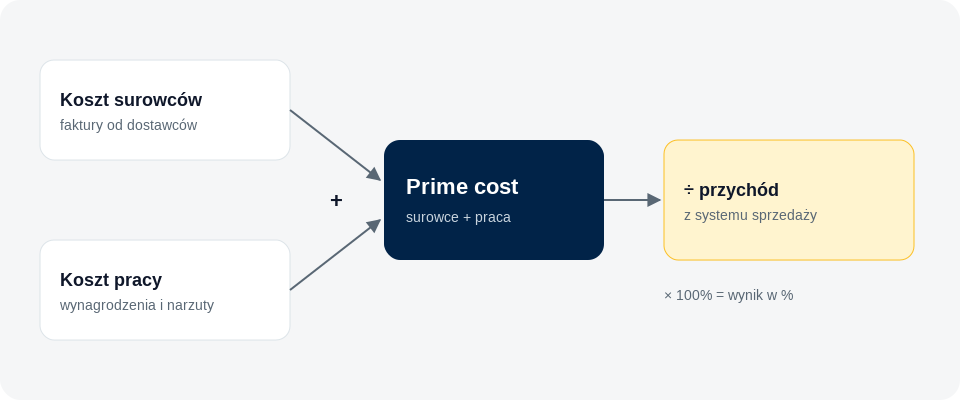
Labor cost alone tells you what share of sales is taken up by wages and the related costs of employment. Even more useful can be prime cost, which combines the cost of ingredients and the cost of labor.
How do you calculate labor cost?
Labor cost = total staff cost / revenue × 100%
Example: say weekly revenue was PLN 30,000, and the labor cost for that period was PLN 9,000.
9,000 / 30,000 × 100% = 30%
In this example, labor cost is 30% of revenue.
How do you calculate prime cost?
Prime cost = cost of ingredients + labor cost
You can also express it as a percentage:
Prime cost % = (cost of ingredients + labor cost) / revenue × 100%
Say that in the same week the cost of ingredients was PLN 8,000, labor cost was PLN 9,000 and revenue was PLN 30,000.
(8,000 + 9,000) / 30,000 × 100% = 56.7%
That does not automatically mean the result is good or bad. You need to compare it with your venue costs, energy, marketing, taxes, financing and other expenses.
How do you interpret the result?
If labor cost rises, don't immediately assume you need to cut the schedule. First check whether the problem comes from costs or from lower sales.
Example: on Monday and Tuesday you have the same staffing as on the weekend, even though sales are much lower. Then the problem may be a mismatch between the number of staff and traffic. On the other hand, on Friday at 7:00 PM an extra person may be needed, even if it temporarily raises labor cost, because without them the kitchen and dining room may stop running smoothly.
What should you do when labor cost is too high?
- compare sales and the number of orders by day and hour,
- check whether the schedule matches the actual workload,
- separate regular working hours from overtime and extra shifts,
- check whether some organizational tasks take up too much of your staff's time,
- compare similar weeks instead of single days.
Ranedo does not calculate labor cost or prime cost. You need to pull cost data from HR, payroll or your own spreadsheets. You can, however, put the sales side together with order and revenue data.
3. Average check or order value
Average order value shows how much a guest spends on average, or how large the average order is in a given sales channel. It is a simple metric that helps you assess your sales mix and how well add-ons, sets and menu changes are working.
How do you calculate average order value?
Average order value = revenue / number of orders
Example: say that over a week revenue from orders was PLN 24,000, and the venue handled 400 orders.
24,000 / 400 = PLN 60
In this example, the average order value is PLN 60.
How do you interpret the result?
A rise in average order value does not always mean improvement. If you raised prices, the average can go up even when the number of items ordered has dropped.
That is why it is worth comparing several figures at once:
- average order value,
- number of orders,
- total revenue,
- most popular dishes,
- sales channels.
Example: if average order value rises but the number of orders falls, check whether it is purely the result of price increases. If both metrics rise, the situation looks different.
What should you do when the average check is low?
Check whether guests have natural ways to expand their order. This is not about pushing everything on everyone. Often a well-built menu is enough:
- sides for the main course,
- drinks with suitable dishes,
- desserts,
- sets,
- size options,
- extra ingredients.
It is also worth analyzing online orders separately. If that channel is important to you, you can read the article on online order conversion.
4. Table turnover
Table turnover shows how many times in the analyzed period a single table was used by another group of guests. In restaurants with dining room service, it helps assess how effectively the available seating is used.
How do you calculate table turnover?
One simple way is:
Table turnover = number of groups served / number of available tables
Example: say the venue has 10 tables and served 25 groups of guests during the evening service.
25 / 10 = 2,5
That gives an example average turnover of 2.5 groups per table in the analyzed period.
You can also calculate turnover for a specific dining room, day of the week or time slot.
How do you interpret the result?
Higher turnover is not always a goal in itself. In a café, a guest may sit at a table longer than in a venue built around fast lunches. In an evening restaurant, a longer visit can be a natural part of the service model.
The metric is most valuable when you compare similar periods. If every Friday between 6:00 PM and 9:00 PM you have a line, but some tables wait a long time for the check, it is worth looking for a bottleneck in service.
What should you do when turnover is too low?
- check the time from when a table is seated to when the order is taken,
- check dish preparation time,
- see whether guests wait a long time for the check,
- analyze whether the dining room layout matches the size of your groups,
- check whether table reservations block tables for too long before the visit.
The goal should not be to rush guests. It is about finding delays that come not from the venue's style but from how work is organized.
5. Guest acquisition cost vs. the value of a regular guest
Guest acquisition cost, often called CAC, shows how much it costs to win one new person who actually made a purchase. In food service, it is especially important to compare this cost with the value of a guest who returns regularly.
How do you calculate guest acquisition cost?
CAC = marketing spend / number of new guests won through that marketing
Example: say you spend PLN 1,000 on a campaign and can attribute 50 new guests to it.
1,000 / 50 = PLN 20
In this example, the acquisition cost of one guest is PLN 20.
How do you compare CAC with the value of a regular guest?
Calculating full customer value can be more complex, but for the owner of a small venue you can start with a simple model.
Say an example regular guest visits the venue twice a month and spends PLN 50 on average. Over 6 months, that comes to:
2 × PLN 50 × 6 months = PLN 600 in revenue
This is not profit. You have to subtract the cost of ingredients, labor and other costs from that amount. But this calculation shows why it is worth looking not only at the cost of the first visit, but also at a guest's return visits.
What should you do when CAC is too high?
First check whether you know which activities actually bring in new guests. If you throw all your marketing spend into one bucket, it is hard to tell what works.
It is worth analyzing separately:
- paid campaigns,
- promotions for new guests,
- flyers and local materials,
- your own website and direct orders,
- activities aimed at current guests.
If winning a new guest is expensive, building return visits becomes even more important. A regular guest does not require paying the full acquisition cost again each time.
How do you combine these metrics into one weekly report?
Don't analyze each metric completely on its own. The most insight comes from putting them side by side.
Example: say that in one week:
- revenue rises,
- average order value rises,
- food cost also rises,
- labor cost stays the same,
- the number of orders falls.
The revenue increase alone might look good. But once you put all the data together, it may turn out that you are selling fewer orders at a higher price while your ingredients cost you more. That is a completely different picture.
A good weekly report can therefore include:
- revenue,
- number of orders,
- average order value,
- food cost,
- labor cost and prime cost,
- table turnover,
- new guest acquisition cost,
- a short note on what changed compared with the previous week.
What data can you check in Ranedo?
Ranedo does not calculate food cost, labor cost or prime cost. You need to pull that information from purchase invoices, HR data, payroll or your own cost spreadsheets.
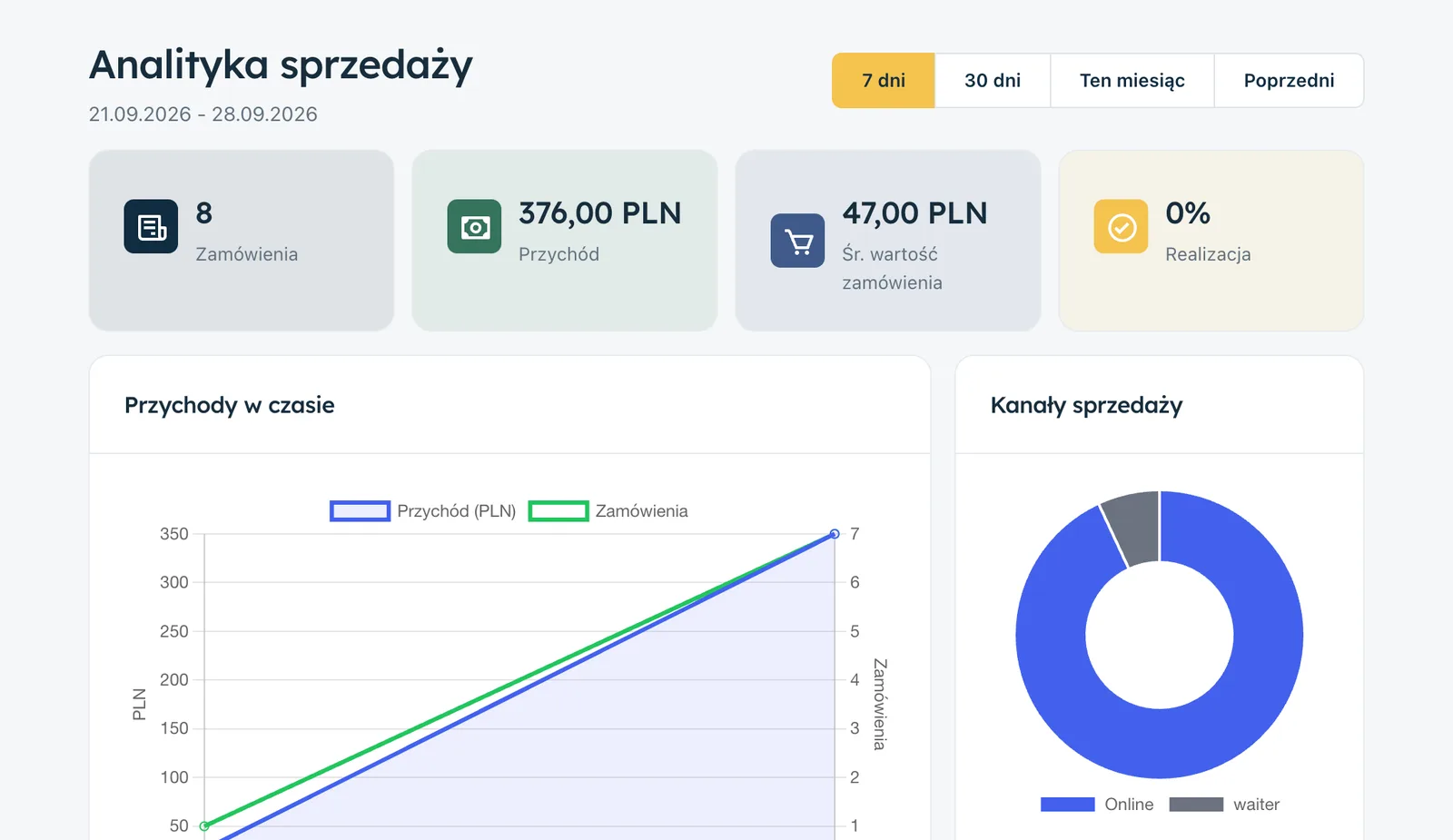
All Ranedo plans do, however, show the sales side: number of orders, revenue, average order value, most popular dishes, sales channels and peak traffic hours. You can also export orders to CSV and combine them with other data in a spreadsheet.
That way you don't have to retype basic sales information by hand. You can put your cost data together with the results from the system and prepare your own weekly report.
You will find more about analyzing your venue's results in the section restaurant results in Ranedo.
Don't look for one perfect number
The biggest mistake is treating single values as universal norms. Rough ranges can be a point of reference, but every restaurant's model is different.
Watching trends is far more important. If your food cost has been at a similar level for several months and suddenly rises, that is a signal to check the cause. If average order value falls for several weeks, it is also worth looking at changes in the menu, sales channels and guest behavior.
The best rhythm is regularity. One report a week gives you more than a very detailed analysis done once every few months.
Check your sales in one place
In Ranedo, sales analytics is available on all plans. You can check the number of orders, revenue, average order value, popular dishes, sales channels and peak traffic hours, and then combine that data with costs from your own spreadsheets.
You can check out the Ranedo plans or create an account and use the first month free, with all the features of the plan you choose.
Frequently asked questions
How often should you calculate restaurant metrics?
For most small and mid-sized venues, a weekly rhythm is practical. It lets you notice changes faster than a monthly analysis, while not requiring full reports to be prepared every day.
Is a 30% food cost always good?
No. Rough ranges of about 25–35% are often cited, but they are not a universal norm. The result has to be assessed in the context of the type of venue, prices, labor cost and other expenses.
Does Ranedo calculate food cost and labor cost?
No. Data on purchases and employment costs has to be pulled from invoices, HR or your own accounting. Ranedo provides sales data that you can put together with your costs.
How does labor cost differ from prime cost?
Labor cost covers expenses related to staff. Prime cost combines labor cost with the cost of ingredients, so it shows a larger part of a restaurant's basic operating costs.
Which metric is the most important?
There is no single metric that is enough to assess a venue. It is best to analyze them together, because a rise or fall in one value often makes sense only alongside revenue, the number of orders and costs.